1.1Basic definitions and properties of linear motion
The simplest motion is motion with constant velocity along a line. If you try to drag a point in this way, then, as every physicist knows, you will not have to apply any force (unless the problem resists!). Let us give several mathematical definitions of linear motion, each of which agrees with our intuitive understanding of what is going on.
From now on we assume that we have an ordinary plane, some objects in which are fixed, while others move as time passes (for convenience we allow time to be negative as well, that is, is an arbitrary real number).
Definition 1.1 (Linear motion). A point moves linearly if it moves along some line and for any three moments of time , , we have
Generally speaking, division by a vector is not defined. Nevertheless, when two non-zero vectors are codirectional, their quotient is defined to be their proportionality coefficient.
An equivalent definition of linear motion is the following:
Definition 1.2 (Coordinate definition). We say that a point moves linearly if its Cartesian coordinates can be written as , where , , , are some constants and is the time parameter.
Generally speaking, it is not obvious why this definition does not depend on the choice of the coordinate system. We will prove this a little later.
Finally, let us give a definition in vector form:
Definition 1.3 (Vector definition). Let a point be fixed in the plane. We say that a variable point moves linearly if there exist fixed vectors and such that . The vector is called the velocity of the point .
Let us check that this definition does not depend on the choice of the point : if is another point, then .
Theorem 1.1. The three definitions of linear motion are equivalent.
Proof
We check that the first definition implies the second, the second implies the third, and the third implies the first. Let a point move linearly according to the first definition, and let be its Cartesian coordinates. The projection of the point onto the line is the point (see Fig. 1.1). By Thales' theorem the ratio of the projections of segments equals the ratio of the segments themselves, so the projection of the point moves linearly according to the first definition.
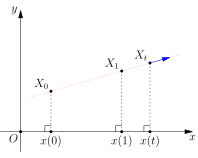
Then (if the trajectory is not parallel to ; otherwise ), whence . In the same way one proves that has the required form.
Let a point move linearly according to the second definition, let be the origin and , the basis vectors. Then , which agrees with the third definition for , .
To get the first definition from the third, it suffices to choose . Then , which means that the point moves along a line with constant velocity according to the first definition: namely, along a line parallel to the vector , covering the length of this vector per unit of time.
Remark 1.1. The argument above automatically implies that the second definition does not depend on the choice of the coordinate system. Indeed, consider two coordinate systems and and suppose that the point moves linearly in the system . Since the point moves linearly in , it moves linearly according to the third definition, and hence also according to the first definition. Since the point moves linearly according to the first definition, it moves linearly according to the second definition in the system as well.
Theorem 1.2. Let points and move linearly, and suppose there are two different moments of time and such that and . Then the points and coincide for all .
Proof
We use the first definition of linear motion. Since there are two moments of time at which the points coincide, the lines along which they move also coincide. If the point moved along this line faster than the point , or in the opposite direction, then after their first meeting the distance between them would keep increasing, contradicting the existence of a second meeting. Similarly, the speed of cannot be less than the speed of ; therefore the velocities are equal, and the points and always coincide.
Definition 1.4 (Linearly moving line). We say that a line moves linearly if there is a vector such that for all we have (where adding a vector means translating by it).
In this definition the vector is not uniquely determined: one can take any vector joining an arbitrary pair of points of the lines and .
Remark 1.2. Linear motion of any object in the plane can be defined in the same way.
Lemma 1.1 (Inheritance of linearity). A line of constant direction drawn through a linearly moving point moves linearly, and the intersection point of two linearly moving lines moves linearly.
Proof
Let us prove the first statement: denote the moving line and the point by and respectively. Then the velocity vector of the point can serve as the velocity vector of the line. Let us now check the second part of the lemma.
The idea of the proof is to “switch” to a frame of reference in which one of the lines is fixed. It is not hard to see that objects that moved linearly in the original frame of reference move linearly in the new frame as well (check this!). And when one of the lines is fixed, the statement of the lemma is obvious.
Let us look at another proof of the statement, one that does not require careful work with frames of reference:
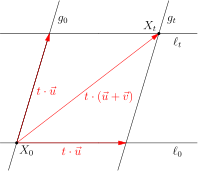
Denote the moving lines by and , and their intersection point by (see Fig. 1.2). For each of these lines choose a velocity vector, and , directed along the other line. Then , so the point moves linearly.
Remark 1.3. Note that a line through two linearly moving points does NOT necessarily move linearly.
Example: suppose the point is fixed and the point moves along a line not passing through . Under such dynamics the direction of the line is not constant; in particular, it cannot move linearly.
Remark 1.4. Students often have trouble understanding what a linearly moving line is. Out of habit, people often think of a line as a set of points. The right concept, however, is to think of a line as an indivisible monolithic object from which one can, if desired, chip off a piece that is a point.
Namely: a linearly moving line is a single whole object, not a set of material points moving in concert. One cannot look at a specific moment of time, choose a point on the line and ask: “Where are you going to move?”
An example showing how absurd such a question is: suppose we have three linearly moving non-parallel lines , and which at the moment meet at a common point but move apart right after that moment. Then the point splits into a triangle whose vertices crawl in different directions.
Thus we get three competing linearly moving points, each of which claims to be called the point . Clearly, one can increase the number of lines and create even more trouble. So how should one explain what is really going on?
The right way to think is that a linearly moving point appears when you intersect two lines. Two linearly moving lines are two whole objects (not sets of points!). It is in our power to intersect these two lines, and then a linearly moving point appears, defined by the fact that at every moment of time it is the intersection of this pair of lines.
So in the example above there are three linearly moving points, which coincide at some moment of time.
Lemma 1.2. Points and move linearly. A point is chosen on the segment so that a) ; b) , where is fixed. Then the point moves linearly.
Proof
Let and . Then the midpoint of the segment has coordinates . If , , and were linear functions of time, the same holds for the midpoint of the segment.
The second part of the lemma is proved in the same way. It suffices to note that
1.1. The vertices of a triangle move linearly. Prove that its centroid also moves linearly.
Remark 1.5. This problem often reveals students' difficulties with the concept of linear motion. More than once I have seen a student reason as follows: the centroid is a material point that has some momentum given by the motion of the triangle. Then the student tried, in vain, to understand where this momentum is directed. In a sense, the student tries to take the centroid at a specific moment of time and then understand its behaviour, “forgetting” that this point must be the centroid of the triangle at every other moment of time as well.
The right understanding is this: at each moment of time we have a triangle, and this triangle has a centroid. If we look at all positions of the centroid at all moments of time, they form the trajectory of some linearly moving point (that is, one can launch a linearly moving point that coincides with the centroid of the triangle at every moment of time).
Let us see with examples how linear motion is used to solve problems:
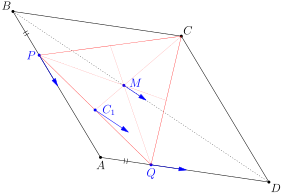
Example 1.1. Points and are marked on the sides and of a rhombus so that . Prove that the centroid of the triangle lies on the diagonal (see Fig. 1.3).
Solution
Fix the rhombus and move the point linearly along the line . Clearly, the point also moves linearly along the line . Denote by the midpoint of the segment . By Lemma 1.2 it also moves linearly. The centroid of the triangle divides the median in the ratio , so, by Lemma 1.2, it moves linearly along some line. We want to prove that this line is ; for this it suffices to find two positions of the point lying on this line. Consider the positions and . In the first case the triangle coincides with the triangle , in the second with the triangle . Since the diagonals of the parallelogram bisect each other, it is easy to deduce that the centroids of both these triangles lie on the diagonal .
1.2. The incircle of a triangle touches its sides and at points and respectively. Points and are marked on the segments and respectively so that . Prove that the midpoint of the segment lies on the line .
1.3. The diagonals of a convex quadrilateral are perpendicular. Prove that the perpendiculars dropped from the midpoints of the sides and to the opposite sides of the quadrilateral meet on the line .
1.4. The sides of a triangle (as lines) move linearly. Prove that the orthocentre, the circumcentre and the incentre move linearly.
1.5. The vertices of a triangle move linearly. Must its orthocentre, circumcentre and incentre move linearly?
1.6. a) The point is fixed, and the points and move linearly along lines passing through . b) The points and move linearly, and there is a moment of time when and a moment of time when . Prove that the orthocentre and the circumcentre of the triangle move linearly.
1.7.★ Using linear motion, prove that the centroid of a triangle divides the segment joining the orthocentre and the circumcentre of the triangle in the ratio .
1.8.★★ Equilateral triangles are constructed outwardly on the sides of a triangle . Prove that their centres form an equilateral triangle.
1.9. Points , , move linearly. It is known that at two different moments of time these points formed similar triangles. Prove that then at any two moments of time the points form similar triangles (or collapse into a point).