2.2Examples of linear functions
Let us give the main examples of linear functions on the plane. Note right away that if and are linear functions, then and (for any constant ) are linear as well.
Definition 2.4 (Oriented line). We say that a line is oriented if a direction is chosen on it. In essence, an oriented line is the same thing as a coordinate axis.
Note that as soon as we orient a line, we automatically divide the plane into the “right” and the “left” sides with respect to this line.
Let an oriented line and a point be fixed in the plane. Consider the function , the orthogonal projection of the vector onto the axis . The projection is taken with the “plus” sign if it is codirectional with the axis, and with the “minus” sign otherwise. From now on we denote this function by . A little more formally, it can be defined as follows:
Definition 2.5 (Projection of a vector onto an oriented line). Let an oriented line and a point be fixed in the plane. Let be the unit vector of the oriented line, directed in the same way as the line itself. We call the function the projection onto the line from the point .
Lemma 2.2. The function is linear.
Proof
Introduce a Cartesian coordinate system so that the line is the axis and the projection of the point onto is the origin (see Fig. 2.3). With this choice of coordinates , which agrees with the coordinate definition of a linear function.
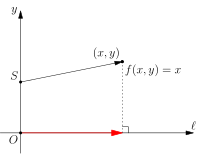
Definition 2.6 (Oriented distance). Let an oriented line be fixed in the plane. The oriented distance from a point to the oriented line is the distance from to taken with the “plus” sign if lies in the left half-plane with respect to , and with the “minus” sign otherwise (see Fig. 2.4). Notation: .
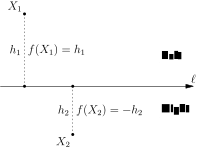
Lemma 2.3. The function is linear.
Proof
Introduce an oriented line perpendicular to and directed into the left half-plane with respect to . Let be an arbitrary point of the line ; then is linear.
Definition 2.7 (Oriented area). Let two points and be marked in the plane. Draw through them the oriented line codirectional with the vector . The oriented area of the triangle (the order of the points and matters!) is the area of the triangle taken with the “plus” sign if the point lies in the left half-plane with respect to , and with the “minus” sign otherwise. Notation: .
Note that by definition .
Lemma 2.4. The function is linear.
Proof
It suffices to note that .
Let us show how linear functions help to solve problems.
Example 2.1. Prove that the sum of the distances from a point inside an equilateral triangle to its sides is constant.
Solution
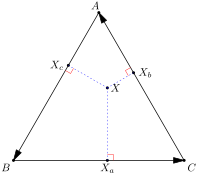
First orient the sides of the triangle counterclockwise, that is, on each line containing a side of the triangle choose the direction corresponding to going around the triangle counterclockwise. Consider the function (see Fig. 2.5). Note that, first, is a linear function; second, for interior points of the triangle coincides with the sum of the ordinary distances to the sides; and , where is the altitude of the equilateral triangle. Since the linear function takes the same value at three non-collinear points, it is automatically constant.
Example 2.2. Let be a quadrilateral with non-parallel sides, and let the rays and , and meet at points , respectively. Then the midpoints of the segments , , are collinear.
Solution
To solve this problem we use the property of a linear function in a slightly different way. Orient the sides of the quadrilateral counterclockwise. Consider the function
Denote the midpoints of the segments , and by , and respectively (see Fig. ). It is easy to see that . Suppose these points are not collinear; then, since the function is linear, for every point of the plane. But it is easy to see that the four vertices of the quadrilateral cannot all satisfy this relation at once (otherwise would be a parallelogram), so the assumption is false, and the points , and are collinear.
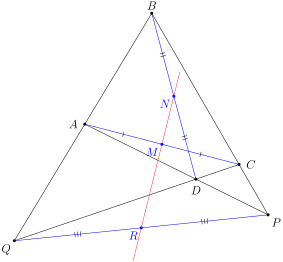
Remark 2.1. This line is usually called the Gauss line.
2.10. A point inside a regular polygon is such that all its projections onto the sides of the polygon lie on the side segments. Colour the segments into which the projections divide the sides in a chessboard pattern. Prove that the sum of the black segments equals the sum of the white ones.
2.11. Inside a triangle there are three non-collinear points with the same sum of distances to its sides. Prove that the triangle is equilateral.
2.12. Prove that the incentre of a tangential quadrilateral lies on its Gauss line.