2.3Applying linear functions to the line
Sometimes linear functions make it possible to describe various lines related to a triangle conveniently.
Lemma 2.5. A non-equilateral triangle is given, its sides oriented counterclockwise. Denote by and its circumcentre and incentre respectively. Let be a real number. Then the set of points satisfying is a line parallel to , and for it is exactly the line .
Proof
Note that the function (see Fig. 2.7) is not constant, since , while at at least one of the points where the incircle touches a side this is not the case. Then the set of solutions of the equation is a line. If such lines for were not parallel, then at their intersection point we would have , which is impossible.
It remains to show that the points of the line satisfy the equation ; by the linearity of , it suffices to show that . The first statement is obvious; let us check the second.
Denote by and the lengths of the sides opposite to the vertices , and respectively. Let and be the projections of the points and onto the line respectively. Regardless of the arrangement of the points, . The other projections are expressed similarly. Then .
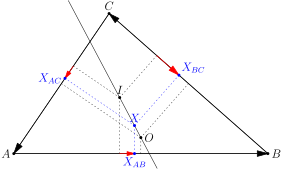
Remark 2.2. Similarly, the line through the circumcentre and an excentre can be given by a linear equation. For example, the line is given by the equation .
Lemma 2.6. A non-equilateral triangle is given, its sides oriented counterclockwise. Then the feet of the three external bisectors of this triangle lie on one line , given by the equation (see Fig. 2.8). Let be a real number. Moreover, for any the equation defines a line parallel to .
Proof
As in the previous statement, it is clear that for different these equations define different parallel lines, so it suffices to show that the feet of the bisectors satisfy the given relations. Let be the foot of the external bisector from the angle . Then . By the property of the bisector, the point is equidistant from the lines and . On the other hand, lies in the positive half-plane with respect to one of the oriented lines containing the sides and and in the negative half-plane with respect to the other, so the sum of the oriented distances to them is zero.
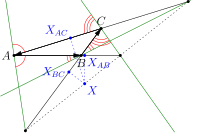
Remark 2.3. Similarly, the line through the feet of two internal bisectors can be given by a linear equation. For example, the line joining the feet opposite to the vertices and is given by the equation .
There is a convenient way to check that lines given by linear equations are perpendicular.
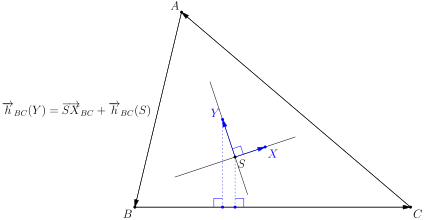
Lemma 2.7. A triangle is given, its sides oriented counterclockwise, as well as a point inside it and real numbers , , and such that the equations and define lines and . Then these lines are perpendicular.
Proof
Consider a point on the line and the point , the image of under the rotation by counterclockwise about (see Fig. 2.9). Orient the altitudes , and of the triangle so that the projections of the vector onto these altitudes equal the projections of onto the sides of the triangle. Then . Note that if we add to the left-hand side of this equality, we get exactly ; hence . It remains to note that this equation defines a line parallel to .
2.13. Denote by and the circumcentre and an excentre of a triangle respectively. Prove that the line is perpendicular to the line joining the feet of the bisectors from the angles and .
Comment: This fact is needed in problem solving much more often than its relative about the line .
2.14. Denote by and the circumcentre and the incentre of a triangle . A point on the external bisector of the angle is such that . Prove that the distance from to the line is three times the inradius of the triangle.
2.15. In an acute triangle with smallest side , points and are marked on the sides and respectively so that . Prove that the line is perpendicular to the line , where and are the circumcentre and the incentre of the triangle.
2.16.★ The incircle of a triangle touches its sides at points , and respectively. Prove that the orthocentre of the triangle is collinear with the incentre and the circumcentre of the triangle.
2.17.★★ In a non-equilateral triangle the point is the incentre and is the circumcentre. A line passes through and is perpendicular to . The line symmetric to with respect to meets the segments and at points and respectively ( and are different from ). Prove that the circumcentre of the triangle lies on the line .