2.4Linear functions in geometric inequalities
Linear functions can also be used to prove geometric inequalities.
Lemma 2.8. Let be a linear function on the plane with and ; then for every point on the segment .
Proof
We use the invariant definition. Since the point lies on the segment , we have with , so .
In the statement of the lemma all signs can be reversed, and also replaced by non-strict ones.
Corollary 2.3. Let be a linear function on the plane. It is known that for some points we have . Then for every point of the convex hull of the points .
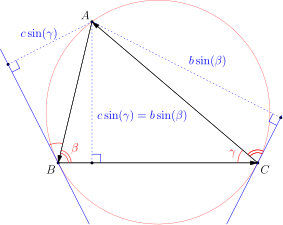
Example 2.3. Let a point lie inside a triangle . Prove that the sum of the distances from it to the tangents to the circumcircle of the triangle at the vertices is at least twice the sum of the distances from it to the sides of the triangle.
Solution
Since the difference of the distances is a linear function, it suffices to check the inequality at the vertices of the triangle. Let . Denote by , the sides opposite to the vertices , and by , the angles at these vertices. Then the sum of the distances from to the tangents equals , while twice the sum of the distances to the sides of the triangle is twice the distance from the vertex to the line , which equals (see Fig. 2.10). Thus we need to prove the inequality , which is equivalent to the obvious inequality .
Unfortunately (or fortunately), linear functions do not describe all the relations that arise between various geometric objects. For example, even if we simply project a moving point from one line to another by a central projection, such a dependence of one point on the other is not linear (at least in the standard Cartesian coordinates!). It is also completely unclear how to solve problems with circles: in most cases linearity is useless here (with the rare exception of the sparrows lemma). So in the following sections we will find out how to reduce problems to checking finitely many positions using more clever functions.
2.18. A point is chosen on the side of a triangle , and points and on the sides and respectively, so that the quadrilateral is a parallelogram. Prove that its area is at most half the area of the triangle.
2.19. Let be a convex pentagon. Prove that the sum of the areas of the triangles , , , , is greater than the area of the pentagon.