3.1Cross-ratios
From now on we will actively use the properties of the cross-ratio of four points on a line or a circle. This section is a quick review of the main definitions and statements.
Definition 3.1 (Projective plane). Consider the plane . Let be the set of all parallel lines of some direction. It is sometimes convenient to think that they all meet at some “point at infinity”. Formally, we declare the set of all lines of a given direction to be the point at infinity of this direction. The set of all points at infinity is formally declared the line at infinity and denoted . The plane together with the additional objects at infinity is called the projective plane.
It is easy to check that exactly one line passes through any two distinct points of the projective plane, and any two distinct lines meet at exactly one point.
This definition of the projective plane has a number of drawbacks. The most obvious one is that the points of the projective plane are, as it were, of two kinds, ordinary ones and points at infinity, and at first glance one has to work with them differently.
There is an invariant definition of the projective plane with no such blatant division of objects into “finite” and “infinite” ones. We will give it in the section devoted to polynomial motion of points.
Definition 3.2 (Cross-ratio of four points on a projective line). Let distinct points , , and lie on a projective line . The cross-ratio of the points on the line is the quantity
We assume that the point at infinity divides any segment in the ratio .
In general, of course, the ratio of vectors is not defined. However, when the vectors and are collinear, there is a real number such that . This number is called the ratio of the vectors and .
This mysterious formula should be understood as follows: there is the simple ratio in which a point divides a segment , defined to be . The cross-ratio of four points is simply the ratio of the two simple ratios in which the points and divide the segment .
Definition 3.3 (Pencil of lines). The pencil of lines of a point is the set of all lines passing through .
Note that the set of all lines of one direction forms the pencil of a point at infinity.
Definition 3.4 (Cross-ratio of four lines of one pencil). Let distinct lines , , , pass through a point . Choose arbitrary direction vectors , , , on these lines. The cross-ratio of the lines is the quantity
By we denote the oriented angle between the vectors and (not to be confused with the directed angle between lines!).
The oriented angle between vectors is the angle by which must be rotated counterclockwise to obtain the vector . With this definition .
The definition and properties of the directed angle can be found in the chapter on polynomial motion.
Remark 3.1. Generally speaking, the sign of is not uniquely determined by the lines and , since a direction vector can be chosen in two ways (pointing to either side along the line). However, if we reverse one of the vectors, the sign changes in two sines at once, and the value of the cross-ratio does not change.
Definition 3.5 (Cross-ratio of points on a circle). Let distinct points , , , lie on a circle . Mark one more point on this circle. The cross-ratio of the points on the circle is the cross-ratio of the lines .
Remark 3.2. The cross-ratio of four points on a circle does not actually depend on the choice of the point , since an inscribed angle is constant. Thus the definition is correct.
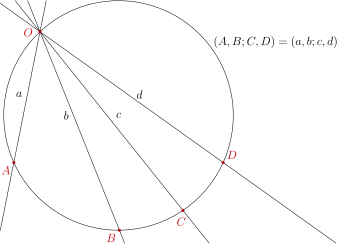
Remark 3.3. For points on a circle . The sign is determined as follows: if the chords and intersect, it is “”, and otherwise “”.
Later we will define the cross-ratio of four points on some other objects as well, for example on conics. For conics the last remark is false.
Let us describe the most important properties of the cross-ratio, which we will use in problems.
Lemma 3.1. Let points lie on a line and let be a point outside this line. Then
Proof
Choose direction vectors on the lines codirectional with the vectors , , and respectively.
The last step holds because
When one of the points or is at infinity (without loss of generality the point ), one should assume by definition that ; one should treat the areas of triangles with a vertex at infinity in the same way.
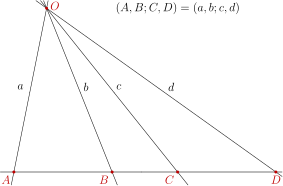
Corollary 3.1. The central projection of a line onto a line with centre preserves the cross-ratio of any four points.
Proof
Let the points , , and go to the points , , and respectively under the central projection.
The cross-ratio is an invariant preserved by a large class of transformations. One way to use cross-ratios in problems is to take some four points and, by a composition of projections, transfer them to some other four points, then write down explicitly the equality of the cross-ratios and draw a conclusion about the relation between these two quadruples.
3.1. a) The point is the midpoint of the segment , and points and on the line are such that . Prove that the point bisects the segment .
b) Points , , , , and lie on a line so that the segments and have a common midpoint and . Prove that the midpoint of the segment also coincides with the midpoints of the segments and .
3.2. a) A line passes through the intersection point of the diagonals of a convex quadrilateral , meeting the lines and at points and and the lines and at points and . Prove that .
b) Prove that the intersection point of the diagonals bisects the segment if and only if it bisects the segment .
3.3 (Butterfly theorem). A line passes through the intersection point of the diagonals of a cyclic quadrilateral , meeting the sides and at points and and the circumcircle at points and . Prove that the intersection point of the diagonals bisects the segment if and only if it bisects the segment .
3.4. A line meets the diagonals and of a cyclic quadrilateral at points and , its sides and at points and , and the circumcircle at points and . It turned out that . Prove that .
3.5.★★ Denote by and the incircle of a triangle and its excircle opposite the vertex . A point is such that is tangent to , and a point is such that is tangent to . The rays and meet at and . Prove that .
Note that the cross-ratio of four points can be equal to if and only if two points of one pair coincide (check this!).
Lemma 3.2. Let points , , , and lie on a projective line, with and the points , and pairwise distinct. Then . In other words, three points and a cross-ratio determine the fourth point uniquely.
Proof
Introduce standard coordinates on the line so that the points have coordinates , , , and . Denote by the known cross-ratio. Then , whence . This is a linear equation in . If it had more than one solution, its coefficients would have to vanish and every would be a solution, in particular . But substituting gives zero on the left, so , a contradiction.
The statement just proved is easy to generalise to a circle with the help of the straightening trick. Let three distinct points , and and two more points and be given on a circle so that . Consider an arbitrary line and an arbitrary point on the circle. Project the circle onto the line through the point ; this transformation preserves all cross-ratios. Since we have already proved the lemma for a line, the images of the points and after the projection coincide, so .
Example 3.1 (Pappus's theorem). Distinct points , , are chosen on a projective line , and points , and on a projective line . Denote by , and the intersections of the lines and ; and ; and . Then the points , and are collinear.
Proof
Denote by and the intersections of and with . The statement of the theorem is clearly equivalent to . Also mark the point , the intersection of the original lines (possibly at infinity), the point , the intersection of with , the point , the intersection of with , and the point , the intersection of with .
Now consider the following composition of central projections between the lines , and (the centres of the projections are shown above the arrows):
Following the arrows, we see that
whence .
Such an argument may seem somewhat mystical. In the next chapter we will discuss in detail how to come up with solutions of this kind by building long chains of projections and some other maps.
3.6.★ a) Points , , and are chosen on one line, and points , , and on another. Denote by , and the intersection points of the lines and ; and ; and . Find a criterion, in terms of cross-ratios, for the points , and to be collinear.
b) Two triangles have a common circumcircle and intersect in a hexagon. Deduce from the previous part that the main diagonals of this hexagon are concurrent.