3.3Homographies
We have defined the cross-ratio on sets of three different types: on a projective line, whose elements are its points; on a pencil, whose elements are its lines; and on a circle, whose elements are its points. For convenience we introduce a general term for sets on whose elements a cross-ratio can be defined.
Definition 3.7 (Projective container). Let be a set whose elements are in a bijective correspondence with the points of a projective line. Suppose also that for any four distinct elements , , and the function is defined. Then we say that the set is a projective container with the projective structure on it.
Note that, generally speaking, many different projective structures can be defined on the same set . Nevertheless, for all sets of interest to us we have a canonical way to define cross-ratios on them. Let us talk about this in a little more detail.
Fix some projective line whose points we will assign to the elements of projective containers. Let be the pencil of lines of some point not on the line . Then to each line of the pencil we can simply assign the intersection point of this line with . Call the resulting map .
Let some four lines , , and of the pencil meet at four points. Now we have two competitors claiming to be the cross-ratio . On the one hand, there is the old definition computing the cross-ratio of four lines via the sines of the angles between them. On the other hand, using we can define a projective structure on by setting by definition. Fortunately, we have already proved that these two definitions agree!
Thus, by means of central projections we can define a canonical projective structure on pencils of lines, and then on all other projective lines and circles (again by central projections).
Definition 3.8 (Homography). Let and be two projective containers. We say that a map is a homography if for any four distinct elements and we have
The definition and the properties proved earlier imply that projections are homographies.
The definition of a homography implies that it is injective, that is, for . Very soon we will see that homographies are in fact bijections.
Let us start with the following important observation: a homography is uniquely determined by its action on three points. For a projective line this follows from the fact that three points and a cross-ratio determine the fourth point uniquely. If is an arbitrary projective container with structure , then implies , and the point is recovered uniquely; since is a bijection, the element is recovered uniquely as well.
Theorem 3.1 (Classification of homographies of lines). Let and be two projective lines and a homography from to . Then:
- can be decomposed into a composition of two central projections (possibly with a centre at infinity).
- is a bijection.
- For any three distinct points , and on the line and any three distinct points , and there is a homography taking to , to and to .
Proof
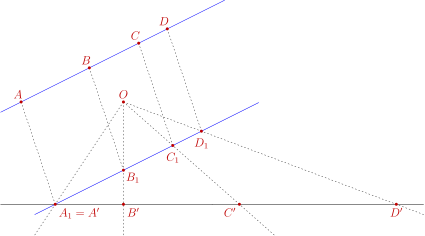
Let the map take the points , , to the points , , respectively.
Draw through the point an arbitrary line and consider any central projection of the line onto the line taking to (for this it suffices that the centre of the projection lies on the line ). Denote the images of the points and under this projection by and .
Mark the point . Denote by the composition of the projection and the projection with centre of the line onto the line . The homographies and act in the same way on the points , and , so they coincide.
Note that the same construction shows that any three distinct points , and can be taken by a homography to any three distinct points , and . Bijectivity of a homography follows from the fact that it decomposes into a composition of central projections, each of which is a bijection.
Let , and be distinct points of a projective line , and , and distinct points of a line . Prove that there is a homography from to that takes the points , and to the points , and .
Lemma 3.3. Let and be two projective containers and a homography from to . Then is a bijection, and moreover is also a homography.
Proof
If and are lines, the statement follows from the classification theorem: decomposes into a composition of central projections and translations. Inverting each of them, we get a map from to which, first, is also a homography (being a composition of projections and translations), and second, is inverse to the map .
If one of the containers is a circle, the straightening trick reduces the problem to the one already solved. One should proceed similarly if a container is a pencil of lines.
Let us introduce one more homography from a circle to itself.
Lemma 3.4. The projection of a circle onto itself preserves the cross-ratio of any four points.
Proof
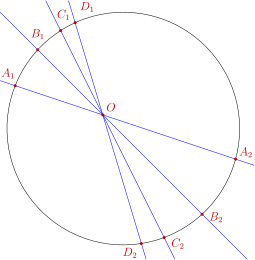
Denote by the centre of the projection in question. If the point , the statement is trivial; from now on assume that . Let the points , , and go to the points , , and respectively under this projection.
First, the cyclic order of the projected four points is the same as that of the original ones, so the signs of the cross-ratios of these quadruples are the same. Second, the triangles and are similar (with exactly this correspondence of vertices), so . Similarly , so . In the same way . Now
An EXTREMELY common mistake! The theorem does NOT guarantee that .
Lemma 3.5. Under the conditions of the previous statement, the map assigning to a point the line of the pencil is NOT a homography.
Proof
Note that under this map each line of the pencil corresponds to two points of the circle. Thus this correspondence is not a bijection, and hence not a homography.
In conclusion, let us discuss how inversion with respect to a circle interacts with the objects discussed above.
Note that when inversion is discussed, it is often assumed that there is one point at infinity, which is swapped with the centre under inversion. This agrees poorly with the fact that the projective plane has a whole line of points at infinity.
What should we do? It is easy to understand how inversion should act on a single projective line, since there is exactly one point at infinity on it. So inversion by itself acts only on the finite part of the plane, but if desired it can be restricted to some projective line, and the image of the centre of inversion can be defined as the point at infinity of this line.
Theorem 3.2. Inversion preserves the cross-ratios of four points lying on one projective line or circle.
Proof
The statement follows from a simple observation: let the inversion with centre and radius take the points and to the points , . Then (this follows from the similarity of the triangles and ).
Using this formula it is easy to express the cross-ratio of four points after inversion through the cross-ratio of the original ones and to see that the two expressions are the same. The details of the computation are left to the reader as an easy exercise.
A reader who has carried the computation in the proof of the previous theorem to the end may have noticed that it is completely analogous to the one in the proof of the fact that the projection of a circle onto itself preserves cross-ratios, and this is no accident!
The point is that an inversion taking one circle to another can be represented as the composition of the homothety of these circles and the central projection of the second circle onto itself (with centre at the centre of the homothety). An inversion taking a circle to a line can be represented as the projection of this circle onto the line with centre at the centre of inversion.
Thus we have in fact long since proved the theorem in all cases except the most trivial one, when a line goes to itself under inversion.