4.1The simplest examples of projective motion
In this section we study a generalisation of linear motion called projective motion. The formal definition will be given a little later. For a while we will move away from the concept of “motion as time passes”.
Let us agree on notation for some special homographies that we will use later.
- is the projection with centre taking the line to the pencil of lines .
- is the counterclockwise rotation about by the angle .
- is the homothety with centre and ratio .
The idea of projective motion is to reduce the statement of a problem to checking that some homography from a line, a pencil or a circle to itself is the identity map. To see that for all , it suffices to check this for only three of them (since a homography is uniquely determined by its action on three points).
Example 4.1. Let be the point where the incircle of a triangle touches the side , and let be an arbitrary point on . Denote by and the incentres of the triangles and respectively. Prove that .
I. Sharygin
Solution
Let us split the solution into several standard steps.
- Imagine that we have drawn the problem in the computer program “GeoGebra”, trying to move the point along the bisector of . Under these dynamics the point moves so that the angle when the point lies on the segment . In general , and we want to check that .
Let us build a homography whose being the identity is equivalent to the problem.
Let us write the “chain” of homographies as a table; denote the bisectors of and , and is the angle at the vertex .
The top row lists the projective containers taken to each other by homographies, and the bottom row the objects moving along them. Clearly, the problem is equivalent to checking that , where and is the composition of all the homographies listed, that is, a homography.
Let us check that the problem holds in some three positions of the point . It is usually convenient to choose degenerate positions. In this problem we consider , where is the incentre of the triangle .
When coincides with the point , the point coincides with , so the statement follows from the fact that the radius of the incircle is perpendicular to the side of the triangle. Similarly for (since in this case ).
When the point coincides with the point , the point coincides with the point , the incentre of the triangle , and the perpendicularity of the lines and follows from the fact that the bisectors of adjacent angles are perpendicular.
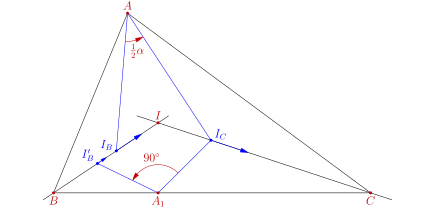
Since a homography is uniquely determined by the images of three points, the constructed map from the line to itself is the identity, so the problem holds for any other position of the point as well.
As an exercise, the reader may think about what the problem turns into when the point “runs away” to infinity.
When writing down the solution we did not use the word motion anywhere. Nevertheless, it is convenient to think that the point moves together with the points and . Later in this section we will use the word “motion” in exactly this informal sense for convenience of exposition. We stress that when writing a solution at an olympiad one should try not to use this term and express everything in terms of homographies.
Common mistakes and how to deal with them
While the reader is only learning this method, we strongly recommend drawing the picture in at least two colours: black for what is meant to be fixed, and blue for what will change if you make a dynamic drawing.
Wrong solutions in which people confuse containers with the objects moving in them are common; so it is worth highlighting these two types of entities in different colours. The right sequence of actions when solving a problem is as follows.
First you should draw a multicoloured picture, imagining how some objects in it will move, and then draw a table of homographies. At every moment you need to make sure that all containers (the first row of the table) are black and all objects (the second row of the table) are blue.
Besides, one needs to make sure that each object lies in the container indicated above it; in particular, if the container is a line or a circle, its object must be a point, and if the container is a pencil, its object must be a line. One also must not forget that the centres of all projections must be black, and the angles of rotations, the ratios of homotheties, and so on, must be fixed.
Consider the following problem:
Example 4.2. A line not meeting the side is drawn through the vertex of an equilateral triangle . A circle with centre touches the side at a point and the lines , . A circle with centre touches the side at a point and the lines , . Prove that the orthocentre of the triangle lies on the line .
Try to find the flaw in the piece of “solution” below by yourself.
Solution
Denote by the orthocentre of the triangle . Note that the angle , so consider the following chain of homographies:
Clearly, the statement of the problem is equivalent to the constructed homography from the line being the identity, so it suffices to check the statement for three positions of the point .
The problem with this solution is that the position of the point depends on the position of the point , so the last projection listed is not a homography (at least, this is not obvious).
* * *
When handling cases where a point runs away to infinity, one should think of it as the direction of the line along which it moves. If one needs to draw a line through a point and the point at infinity moving along a line , one should draw the line through parallel to .
From now on, for brevity, we will say that points (lines) and depend on each other projectively, or move projectively, if , where is some homography. When solving problems it is useful to start moving not only points but also lines.
4.1. A triangle and points , on the sides , are given such that the lines , meet on the altitude of the triangle. Prove that the lines and are symmetric with respect to .
4.2. The external bisectors and of a triangle meet at a point . A line through meets the lines and at points and respectively. Prove that the lines symmetric to the lines and with respect to and meet on .
4.3. A point lies inside a triangle . Points , and are chosen on the segments , and respectively. Let . The points , are defined similarly. Prove that the lines , and are concurrent.
4.4. The point is the midpoint of the base of a trapezoid with . A line through meets the lines and at points and respectively. Prove that the lines and are symmetric with respect to the line .
Let us practise proving equalities of angles by projective motion. Note that an angle is a function of two rays from one point, whereas homographies interact well with lines through one point. So statements about equal angles must first be reformulated in terms of equal directed angles between lines.
Definition 4.1. The directed angle between an ordered pair of lines is the angle by which the line must be rotated counterclockwise to become parallel to the line .
Remark 4.1. Directed angles are not the same as the oriented angles we used to define the cross-ratio of four lines. Directed angles are defined modulo and are a function of a pair of lines. Oriented angles are defined modulo and are a function of a pair of vectors.
Lemma 4.1. A line passes through a point , and a line through a point . Consider the map taking each line of the pencil to the line of the pencil such that . Then the map is a homography.
Proof
Consider the motion of the plane (a composition of a translation and a rotation) taking the point to the point and the line to the line . Consider the map taking each line to its image under this motion. On the one hand, is clearly a homography of pencils (since preserves the angles between lines); on the other hand, it acts on lines exactly like , that is, .
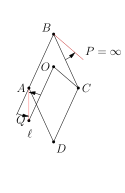
Example 4.3. A rhombus with an acute angle is given. The point is the circumcentre of the triangle . A point is chosen on the extension of the ray beyond . The line meets the line through parallel to the side at a point . Prove that
Solution
Let us immediately reformulate the problem in terms of directed angles and use the parallelism. We want to show that .
Fix the rhombus and mentally rotate the line within the pencil . Let us build two homographies whose coincidence is equivalent to the statement of the problem:
Here is the map of pencils from the lemma taking the line to the line such that .
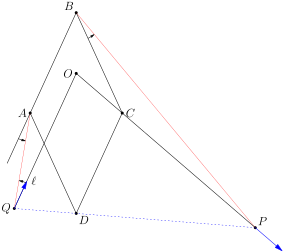
For the line meets the line at the point . Then , as required. For more rigour, the same equalities can be rewritten in directed angles: .
For the line meets at the point at infinity of the line , so the line is parallel to the line , that is, it coincides with the line . Thus both directed angles in question are zero.
Finally, for the line , so is a parallelogram (since also ). Further, , so the quadrilateral is also a parallelogram. Now .
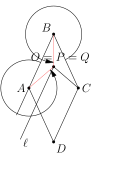
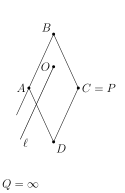
Remark 4.2. Very often, when solving this problem, people forget that it must first be reformulated in terms of equal directed angles. Such people first prove, not very carefully, that it suffices to check the problem in three positions of the point , and then, when checking the position , they run into trouble, not understanding what has to be proved in that case.
When solving problems it is useful to use the notion of a projective angle, a variable directed angle between a fixed line and a projectively rotating one. It is easy to see that adding a fixed angle to a projective angle again gives a projective angle. Three positions are needed to check that projective angles are equal (this is a simpler reformulation of Lemma 4.1).
4.5. Points and (not necessarily distinct) are given. Consider the map taking each line of the first pencil to the line of the second such that . Prove that is a homography.
4.6. Let distinct points and be fixed, let a line rotate about the point , and let be the projection of the point onto the line .
a) Along which trajectory does the point move? Prove that the point is obtained from the line by some homography. Between which projective containers does this homography act?
b) The same questions for the point symmetric to with respect to the line .
4.7. Let be a fixed line and a fixed point. If a line passes through the point and forms a projective angle with , then is a projectively rotating line.
4.8. In an acute triangle an arbitrary point is chosen on the altitude . The points and are the midpoints of the sides and respectively. The perpendicular dropped from to meets the perpendicular dropped from to at a point . Prove that the point is equidistant from the points and .
4.9.★ The excircle of a triangle opposite the vertex touches the ray at a point and has centre . A point is chosen on the segment . The point is the incentre of the triangle , and is the centre of the excircle of the triangle tangent to the side . The lines and meet at a point . Prove that the points , , and are concyclic.
4.10.★★ Denote by and the midpoints of the sides of a triangle respectively. Let be a point on the tangent to the circle at . A circle touches the line at and passes through the vertex ; is defined similarly. Prove that one of the intersection points of lies on .