4.2Additional lemmas, clever homographies
As we have seen, homographies are a powerful tool for solving geometry problems. To solve harder problems we need to replenish our arsenal of homographies with more clever maps that preserve cross-ratios.
Let us start with the following lemma, often used in everyday life:
Lemma 4.2 (Transferring a circle to a tangent). A circle and a line tangent to it at a point are given. For each point of the line denote by the point of tangency of the second tangent from to . Then the map taking each point to and the point to itself is a homography.
Proof
Denote by the point diametrically opposite to on . Let . Then , so the point is obtained from the point by projecting the pencil of the point onto the circle .
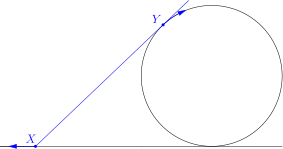
Remark 4.3. When using the lemma in problems, the two most common mistakes are the following. First, people often forget where the point goes under the map, so they are afraid to analyse the corresponding degenerate positions and cannot finish the problem. The second common mistake is trying to apply the lemma when the line is not tangent to the circle.
In particular, it is useful to remember the following simple result.
Lemma 4.3. A line is NOT tangent to a circle . Then the map assigning to each point of the line the point of tangency of one of the two tangents to is NOT a homography.
Proof
Suppose the contrary and consider the inverse map assigning to each point its point ; this map must also be a homography. On the other hand, when the point runs once around the circle , each point of the line (except the common points of the line and the circle) is covered by either zero or two tangents. But, as we know, a homography must be a bijection, a contradiction.
Try to solve the following problems using the lemma just proved.
4.11. A circle with centre touches the sides of an angle at points and . A line parallel to the line passes through the point and meets the lines and at points and respectively. An arbitrary point is marked on the segment . The lines and meet at a point . A line parallel to the line passes through the point and meets the line at a point . Prove that the line is tangent to the circle .
4.12. A point is chosen on the side of a square . The line meets the line at a point . Prove that the tangent from the point to the incircle of the square bisects the segment .
4.13. The bisectors of a triangle meet at a point , and perpendiculars , and are dropped from this point to the sides , and . The point is the midpoint of the segment . A point is such that . Prove that .
The Big New Year Math Battle
4.14. A circle is inscribed in a trapezoid and touches the sides , , and at points , , and respectively. The line through the point parallel to the bases of the trapezoid meets the line at a point . Prove that the lines , and are concurrent.
4.15. Let , , be the excircles of a triangle tangent to the sides , , respectively. Denote by the common external tangent of the circles and other than . Define , similarly. From a point on draw the tangent to other than and find the point where it meets . Similarly find the point where the tangent from to meets . Prove that the line is tangent to .
Unfortunately, in real life one sometimes meets problems in which one really wants to map a line to a circle by tangents even when the line is not tangent to the circle. Of course, this is not allowed, but in some cases another lemma helps to replace it. Try to prove it yourself and then use it in the solution of a competition problem:
4.16 (Transferring a circle to itself through a line). A line and a circle are fixed in the plane. For a variable point we construct the point , the intersection of the tangent to at the point with the line . The point is the point of tangency of the second tangent from to . Prove that the map taking the point to the point is a homography.
4.17. A quadrilateral is circumscribed about a circle . The diagonal meets at points and . The point is the midpoint of the segment . Prove that