4.4Poncelet homographies
Let us state Poncelet's porism for a triangle:
Theorem 4.1. A triangle is inscribed in a circle and circumscribed about a circle (possibly externally). Let a point also lie on , and let the tangents from it to meet again at points and . Then the line is tangent to .
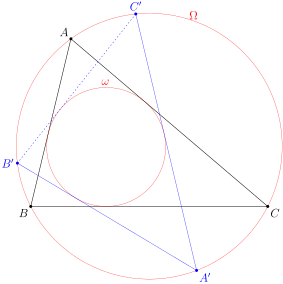
One possible proof can be found in the chapter on conics.
Thus the triangle can be rotated while keeping its incircle (or excircle) and circumcircle. In this case we will say that the triangle rotates in the Poncelet way.
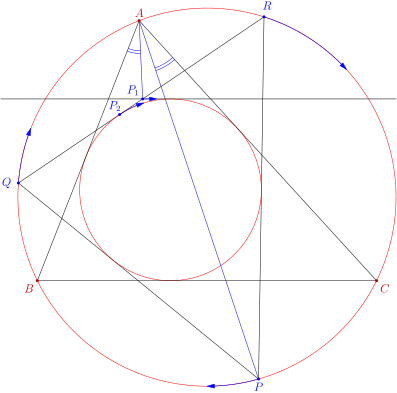
Example 4.4. A convex hexagon is inscribed in a circle , and the triangles and are circumscribed about the same circle . A line parallel to the line and different from it is tangent to . Let be the intersection point of the line and the segment . Prove that .
Solution
Let us try to move the point along the circle , keeping the triangle fixed. By Poncelet's porism, we can correctly reconstruct the whole picture for any position of the point . The line depends projectively on the point , and so does the line symmetric to it with respect to . Intersecting this line with the line at a point , we see that the point depends projectively on the point . If the problem we are solving is true, the point must always coincide with the point ; in particular, it must also be the image of the point under some homography.
Let us try to prove our conjecture. By the lemma on transferring a circle to a tangent, the point depends projectively on the point , the point where the line touches the circle . So, to show that the point depends projectively on the point , it suffices to show that the map taking the point to the point is a homography.
At this moment we realise that we need neither the triangle nor the line : there remains just a statement about Poncelet's porism: we need to show that the point where the segment touches the incircle depends projectively on the point . Let us prove this.
Consider the projection of the circle onto itself with centre . Under this projection the point goes to a projectively moving point , the midpoint of the arc . The tangent to at the point is parallel to the line , so the point is the image of the point under the homothety taking the circle to the circle .
A concise write-up of this problem at an olympiad using a table would look like this (of course, one has to describe the homographies and ):
The statement of the problem is equivalent to the homography taking the point to the point being the identity, so it suffices to solve the problem for some three positions of the point . The positions are obvious.
Definition 4.2 (Poncelet homography). The projective map constructed in the solution of the problem is called the Poncelet homography.
Remark 4.4. Sometimes it is useful to consider dynamics in which the circumcircle and an excircle of the triangle are fixed. Note that under Poncelet rotation adjacent vertices of the triangle do not depend on each other projectively unless the rotating triangle is equilateral. A rigorous proof of this fact will be given in the final part of the book.
4.29. A triangle rotates in the Poncelet way. Prove that the midpoint of the arc depends projectively on the point .
4.30. Let and be two triangles having a common incircle and circumcircle . Let be the point where touches , and define similarly for . Let be the intersection of and , and the intersection of and . Prove that the lines , , and are concurrent.
4.31.★★★ A closed polygonal line is given whose vertices lie on a circle and whose edges are tangent to . Prove that when this polygonal line rotates keeping and , the point of tangency of the edge depends projectively on the point .