5.1Connection with linear motion
Let us finally formalise the term projective motion by tying it to the linear motion we already know. To begin with, it is worth saying what motion is in general.
Definition 5.1. Fix a line in the plane. Introduce standard Cartesian coordinates on this line. We will call this line the time line, and its points moments of time. Let a function be given that assigns to each moment of time some point . We will call such a function a moving point, and the point the position of the moving point at the moment . The notion of a moving line or any other object can be defined similarly.
Remark 5.1. One can see that the definition of motion is rather general. In particular, the functions need not have any nice properties. Nevertheless, in this book we study only functions that are nicely defined in coordinates. For example, linear motion is just those functions that are given in coordinates by functions linear in time.
Let us also additionally assume that the time line is projective, thinking that a linearly moving point at the infinite moment of time becomes the point at infinity of its straight trajectory. This technical clarification will help us describe what is going on a little better later.
Definition 5.2. Let points and move with time along projective containers and respectively. We will say that these points are projectively dependent if there exists a homography such that .
Clearly, any point is projectively dependent on itself; also, if is projectively dependent on and on , then the points and are also projectively dependent.
Lemma 5.1. Any two linearly moving points are projectively dependent.
Proof
Let the point move along the line and the point along the line . Consider the homography of lines taking to , to , and the point at infinity to the point at infinity.
Let us finally introduce the notion of projective motion.
Definition 5.3 (Projective motion). Let be some projective container. We will say that moves projectively if it is projectively dependent on some linear point.
It follows from the lemma proved above that if a point is projectively dependent on some linear point, then it is projectively dependent on every linear point.
Remark 5.2. Note that in the definition of projective motion may be not only a point of a projective line (circle) but also a line of a pencil.
Let the points and move linearly and the point projectively. Sometimes it is convenient to change the dynamics and start moving the point linearly. In that case the points and will not necessarily move linearly, but the relation between them is simpler than an arbitrary projective dependence. In such a case we will say that the points and are linearly dependent.
5.1. Points and are fixed, and a line rotates projectively about the point . Then a) the projection of the point onto ; b) the point symmetric to with respect to moves projectively along some circle.
5.2. Points and move linearly along lines meeting at a point . Let be some fixed circle passing through the point . Show that the second intersection point (or the point of tangency) of the circle with moves projectively or stays fixed.
Let us finally answer the question of what the function defining a projectively moving point looks like in coordinates.
Theorem 5.1. A point moves projectively along a line if and only if .
Proof
First let us show that the first coordinate depends on time as a linear fractional function. Let be the projection of onto the coordinate axis . Clearly, the point also moves projectively. Let the point (and hence ) have first coordinate , and at the moments of time , and . Let this coordinate equal at the moment .
In this case , that is, , which shows that depends on time as a linear fractional function. Similarly for . It remains only to note that the denominators of the expressions for and vanish simultaneously (when goes to infinity).
Remark 5.3. A point moving projectively along a circle has a somewhat more complicated description in coordinates. This is one of the reasons why we started studying projective motion in the language of homographies, without trying to write everything in coordinates right away by analogy with linear motion.
Let us see how combining linear motion and homographies helps solve problems.
Example 5.1. An acute triangle with orthocentre is inscribed in a circle . A line passing through meets the sides and at points and respectively. A circle passing through the points , and meets again at a point . The line meets again at a point . Prove that .
Solution
Fix the triangle and move the point linearly along the fixed line . Under these dynamics the lines and move linearly, so the points and also move linearly; hence the centre of the circle moves linearly along some line . Mark the fixed point on the circle such that , and the point , the intersection of with . Denote by the centre of .
Denote by the projective map assigning the point to the point . In this notation the table of homographies looks as follows:
The statement of the problem is equivalent to the points and coinciding, so it suffices to prove it for some three positions of the point .
The positions , are obvious. Let us analyse the position in detail. Note that in the case the point coincides with the midpoint of the segment , where is the point on the line such that . Similarly for , so the trajectory of the point is the midline of the triangle parallel to the side .
Clearly, when the point runs away to infinity, the points , and also become points at infinity; it makes sense to think of them as directions. The line becomes the line through parallel to the line .
The point becomes the intersection of the altitude of the triangle with , that is, the point diametrically opposite to the point (since the lines and are antiparallel inside the angle ). Finally, the line is parallel to , that is, meets it at the point at infinity, which is .
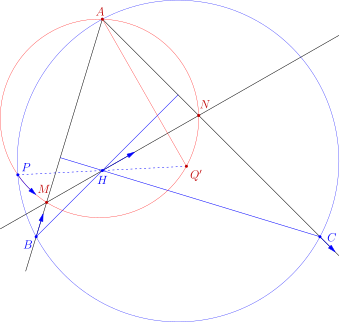
5.3. A triangle with is inscribed in a circle . Denote by the midpoint of the arc . A line parallel to meets the sides , and the extension of the side beyond the point at points , and respectively. The line meets again at a point . Prove that the points , , and are concyclic.
5.4. Let a point move projectively along a line. Show that the point moves linearly if and only if it runs away to infinity at the infinitely large moment of time.
5.5. A point is marked on the circumcircle of a triangle . The lines and meet the altitudes and at points , respectively. Prove that the midpoint of the segment lies on the line .
By analogy with how we proved the collinearity criterion for three linearly moving points, let us try to understand how to check collinearity of three linear fractional points.
Theorem 5.2. Let three points , and move as linear fractional functions of time. If there exist four distinct moments of time at which these three points are collinear, then they are always collinear.
Proof
Unfortunately, if we act through Cartesian coordinates without additional algebraic considerations, we only manage to show that five positions suffice. In the chapter on polynomial motion of points we will discuss a natural algebraic proof of the theorem; for now we present a trick that uses the notion of a projective transformation of the plane (one can read about it in any textbook on projective geometry).
Let the points become collinear at the moment of time . Consider the new variable . It is easy to see that , so linear fractional functions of are also linear fractional functions of . Let us now think that our time is rather than ; then our three points still move as linear fractional functions.
Note that for (respectively, ) our points lie on one line . Apply a projective transformation of the plane taking to the line at infinity. Since a projective transformation preserves cross-ratios of points on lines, the images of the points after the transformation also move projectively.
Now for our three points run away to infinity, so all of them move linearly. We know that these three linear points were collinear three times at finite moments of time, so they are always collinear.
The theorem has a useful corollary that helps prove that quadrilaterals are cyclic.
Lemma 5.2. Three points , and move projectively along three lines or circles having a common point . It is known that the points , , and were concyclic (or collinear) four times. Then they are always concyclic. If one of the points , or coincides with (say ), the concyclicity condition is replaced by the condition that the circle is tangent to the trajectory of the point . When two of the points arrive at simultaneously, the condition is replaced by the condition that the third point also arrives at . When two points merge outside the point , the concyclicity condition is considered automatically satisfied.
Proof
Consider the inversion with centre at the point and any radius. Denote by , and the images of the points after the inversion. It follows from the hypothesis that the new points move projectively along lines and we need to check their collinearity, so it does indeed suffice to check the statement of the problem in four positions.
It remains to interpret carefully what happens in the degenerate cases. Let us start with the simplest degeneration, when two points and merge outside the point . In this case, after the inversion the points , and are automatically collinear.
If the point merges with the point , then after the inversion one has to check that the points and are collinear with the point at infinity of the straight trajectory of the point , that is, that the line . Before the inversion this meant exactly that the circle was tangent to the trajectory of the point .
When and merge with the point simultaneously, after the inversion these points become two points of the line at infinity. Hence the third point must also be at infinity, but then before the inversion it coincided with the point .
5.6. A triangle with orthocentre is given. Points and are chosen on its circumcircle so that the lines and are concurrent. Denote by and the points symmetric to , and with respect to the midpoints of the corresponding sides of the triangle. Prove that the points and are concyclic.
5.7. Two perpendicular lines are drawn through the orthocentre of an acute triangle. Prove that the midpoints of the segments cut out by these lines on the sides or on the extensions of the sides of the triangle are collinear.