5.2Projective involution and inversion
Definition 5.4 (Projective involution of a line). We will say that a homography of a projective line is a projective involution if for every point .
The simplest example of a projective involution is the identity transformation. A point reflection whose centre lies on also defines a projective involution of .
A slightly trickier example, which we have already met, is an inversion restricted to a projective line. Note that since inversion preserves cross-ratios, the inverse image of a projectively moving point is always a projectively moving point too.
Theorem 5.3. Every non-identity projective involution of a projective line is either an inversion, or a point reflection, or a composition of an inversion and a point reflection whose centre coincides with the centre of that inversion. Moreover, if is an inversion with fixed points , , then .
Proof
Consider two arbitrary points and such that , and put , . The idea of the proof is to construct a function , which is a reflection, an inversion or their composition depending on the arrangement of the points, that swaps the pairs and .
Introduce coordinates on the line with origin at a point , and denote by the coordinates of the points in question. Let us try to find a point with coordinate such that . For this it suffices to find such that , and this is a linear equation in (since the leading coefficients on the left and right cancel).
If , we solve the linear equation and find a suitable ; otherwise note that the segments and have a common midpoint , and denote by the reflection with centre at the point . In the case where we have constructed the desired point , it is easy to see that either lies on each of the segments and , or it lies on neither of them. In the first case denote by the composition of the inversion and the reflection with centre at the point , in the second the inversion with centre and radius .
In any case for , and , so, since these are two homographies, they coincide identically.
Remark 5.4. Along the way we have proved that for any four points and there exists a projective involution swapping the points and and also the points and . Moreover, such an involution is unique.
Remark 5.5. The centre of the inversion (of the composition of an inversion and a reflection) defining a projective involution is swapped by this involution with the point at infinity of the line. Sometimes this can be used to find this centre explicitly. In what follows we will call the centre of an involution exactly the centre of the inversion (composition of an inversion and a reflection) defining it.
All projective involutions of a circle are described very easily.
Example 5.2. Let be a projective involution of a circle. Then there exists a central projection of to itself that coincides with .
Proof
Choose a point on the circle. Let . Now let be a point different from these two, . Denote by the intersection of the lines and (possibly at infinity). The projection of the circle to itself with centre at the point acts on the points , and in the same way, so these two homographies coincide.
A projective involution can be “transferred” using maps that preserve cross-ratios.
Example 5.3. A triangle is inscribed in a circle . A point is such that . The points and are defined similarly. Prove that the lines , and are concurrent.
Proof
By the lemma it suffices to show that there exists a projective involution of the circle swapping the points in the pairs , and . Apply an inversion with centre at the point and arbitrary radius. We denote the image of each point by .
We wish to show that there exists a projective involution swapping the pairs of points , and . Since the point is at infinity, the desired involution must be an inversion with centre at the point .
Since , the point is the midpoint of the segment . Denote by the length of the segment . Since , is the midpoint of the segment , or . Similarly , so the inversion plus reflection with centre at the point and radius is the desired involution of the line.
5.8. Points and are marked on a circle , and a point outside it so that and are tangent to . Points and on are such that the segment bisects the segment . Prove that the rays and are symmetric with respect to the bisector of the angle .
5.9. Variable points and are chosen on a line . A point outside this line is fixed. Prove that the circles have a second common point (or are all tangent to each other at one point) if and only if the map is a projective involution.
5.10. Lines and meeting at a point are fixed in the plane. A point is fixed on the line , and a point outside the lines. Variable points on the line are considered such that the angles and are equal. Prove that the centres of all circles are collinear.
5.11. Six coins lie on a table, touching each other in a cycle. A seventh coin is between them, touching each of them. Prove that the six points of tangency can be split into three pairs so that the segments joining paired points are concurrent.
Sometimes the number of positions to be checked can be reduced considerably by using the properties of a projective involution skilfully.
Lemma 5.3. Let be a homography of a line, and let points on this line be such that and . Then is a projective involution of the line.
Proof
Since is not the identity map, there is a point on the line such that and . Consider the projective involution swapping the pair and and also the pair and . The homographies and coincide at three points, so they coincide identically.
Remark 5.6. This lemma can sometimes be used to reduce a problem to checking a single position. Indeed: suppose the problem turned out to be equivalent to some projective map being a projective involution. Suppose the problem holds for some position of the point . Then for this position . Put and note that , so if , we win by the lemma.
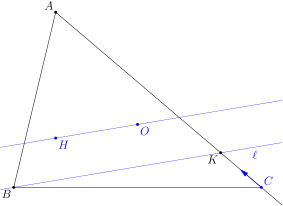
Example 5.4. The Euler line of a triangle with meets its sides and at points and . Prove that the Euler line of the triangle is parallel to the line .
Solution
Fix the points and , and move the point linearly along the line . Under these dynamics the orthocentre and the circumcentre of the triangle move linearly, so the vector changes linearly, and hence the direction of the line is projective.
Draw through the point the line parallel to the vector ; by the above, it rotates projectively. Let meet the line at a point ; then it suffices to show that the Euler line of the triangle is parallel to the line . Denote by the projective map taking the direction of the line to the direction of the line .
Note that takes the direction of the line to the direction of the Euler line of the triangle (and this is the direction of the Euler line in question), so in fact we just want to see that is a projective involution of the line at infinity. By the lemma just proved, for this it suffices to check the statement of the problem at just one point that is not a fixed point of the involution.
Choose the position of the point such that . The Euler line of such a triangle is the perpendicular bisector of the segment . Since this perpendicular bisector is not parallel to , we have not hit a fixed point of the involution. The Euler line of the triangle is its median from the vertex (since the point is its orthocentre), which is obviously parallel to .
Lemma 5.4. A line and two points and outside it are given. Consider the map from to itself taking a point to the second intersection of the circle with the line (if and are collinear, the second intersection is the point at infinity). Then is a projective involution.
Proof
If , the statement is obvious; otherwise mark the point , the intersection of the lines and . By the power of a point, the product is constant, so is an inversion or a composition of an inversion and a reflection, which implies the claim.
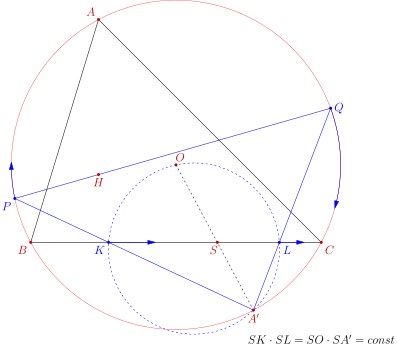
Example 5.5. An acute triangle with orthocentre is inscribed in a circle with centre . A line passes through and meets the smaller arcs and at points and respectively. Let be a diameter of the circle . The lines and meet at points and respectively. Prove that the points , , and are concyclic.
Solution
- Move the point along the line , keeping the triangle fixed.
Denote , and let the point be such that and lies on the segment (thus the points , , and are concyclic). Also denote by the inversion with radius and centre at the point .
- Clearly, one can mentally start moving the picture not from the point but from the point . Choose the positions , , (projective maps are bijections, so for each position of there is exactly one position of ). Each of these positions is obvious and is left to the reader as an exercise.