5.3Tangency of circles
In some cases projective motion can be used to prove tangency of circles (even when the point of tangency is not known a priori!). Let us start with the following rather well-known construction:
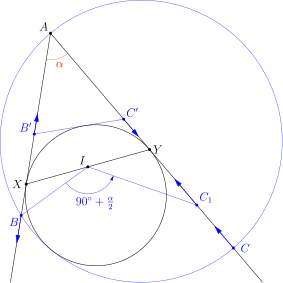
Example 5.6. Verrier's lemma. A circle is circumscribed about a triangle . A circle touches the segments and at points and respectively, and also the circle . Prove that the incentre of the triangle lies on the segment .
Solution
Fix the angle and the circle , and move the point projectively along the line . The point is defined as the second intersection of the variable circle with the line . Mark the point , the midpoint of the segment . To show that is the incentre of the triangle , it suffices to check that , since there is only one point with this property on the bisector of the angle . Mark the point so that ; then the point also moves projectively.
Let us check that the point moves projectively. Apply an inversion with centre at the point and arbitrary radius. Then the point , the image of the point , moves projectively along the line (since inversion preserves cross-ratios), and becomes the tangent from the point to the circle (the image of the circle ).
The point is the intersection of the line with . Denote by the centre of the circle . Since , the point moves projectively, and then the point moves projectively too.
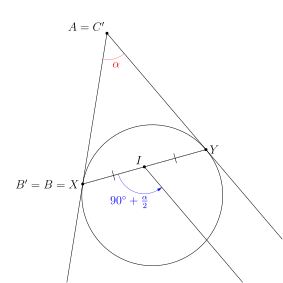
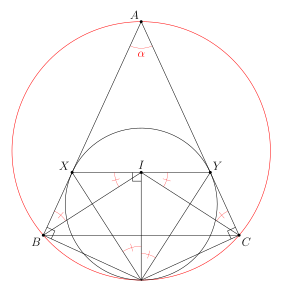
To solve the problem it suffices to show that , so it suffices to check three positions of the point . Consider the positions where , where , and where .
The first two positions are equivalent; let us analyse only the case . It is easy to see that the point is the point at infinity of the line . The point coincides with , so the point coincides with the point (see the definition and the remark on transferring from a circle to a tangent). Since is obtained from by an inversion with centre at the point , we get that is also the point at infinity of the line .
Let . Denote by the point of tangency of the circles, which is the midpoint of the smaller arc of the circle . The points are collinear; intersect this line with at a point . Since , the quadrilateral is cyclic, hence , so . Similarly . Moreover, , so the point is the incentre of the triangle . Summing up, we see that .
One can define the angle between a line and a circle meeting it as the angle between the line and the tangent to the circle at the intersection point; and the angle between two intersecting circles can be defined as the angle between the tangents to them at their intersection point.
It is well known that inversion preserves angles defined in this way.
The following amusing statement was communicated to me by Roman Prozorov.
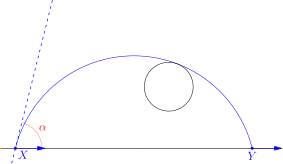
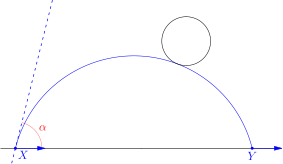
Lemma 5.5. A line , a circle not meeting it, and an angle are fixed in the plane. For a point we construct the circle that passes through the point , touches the circle internally and forms the angle with the line (always on the same side). Then the point , the second intersection of the circle with the line , depends projectively on the point .
Proof
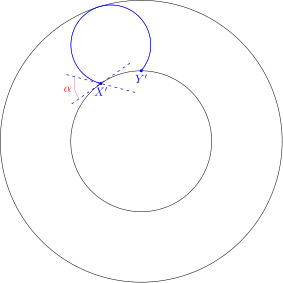
Let us show that there is an inversion taking the circle and the line to a pair of concentric circles: let be the projection of the centre of onto . Draw from the tangents and to and construct the circle with radius and centre at the point . Let the line of centres of the circles and meet at points and . An inversion at either of these two points with any radius gives what we want. Apply the inversion . It is easy to see that the conjugated map is just a rotation of the circle by a fixed angle, which certainly is a homography.
Of course, in the statement of the lemma internal tangency can be replaced by external tangency; the argument does not change. In fact, the fact in some reformulation also holds for intersecting and . However, stating it correctly is harder than proving it: as in the case of non-intersecting circles, the circles split into two independent families, each of which gives its own projective map.
When the point is outside the segment formed by the intersection points, these families can again be distinguished by the type of tangency of with . When the point lies on the segment, the circles split into “right” and “left” ones, depending on which side of the tangent line they curve to.
Let and be the intersection points of with . The first family can be described as follows: while the point is to the left of , the circles touch externally; then, when the point gets onto the segment , the circle becomes “left”, and when passes beyond the segment , the circles touch internally. The second family is arranged exactly the other way round.
Unfortunately, an intersecting circle and line cannot be turned into concentric circles by an inversion, so the original proof becomes unusable. Instead, let us apply an inversion with centre at the point and any radius.
After the inversion and are two lines, along one of which the points and move. Denote by the point of tangency of the circle with . The angle equals , so under our dynamics the triangle simply undergoes homotheties inside the angle in question, so the points and depend on each other linearly.
Remark 5.7. In this case we also get for free that the point of tangency of with depends projectively on the point as well, which is not at all obvious in the case where and do not intersect.
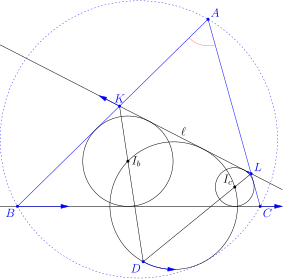
Example 5.7. A triangle is inscribed in a circle . Circles and with centres and respectively are inscribed in the angles and respectively. The line is a common external tangent of these two circles. The line meets the sides and at points and respectively. The lines and meet at a point . It turned out that the circle circumscribed about the triangle is tangent to . Prove that then this circle is also tangent to .
Solution
Fix the circles and and move the point projectively along ; the points and move projectively along the line , and the points and move projectively along the second common external tangent of the circles. Note that the sum is fixed, hence the sum is fixed, since it is twice as large. But then the sum is fixed, that is, is fixed; denote it by .
It suffices to check the statement of the problem in three positions and to make sure that the resulting circles lie in the same family (then we apply the lemma to the line , the point moving along it, the circle and the angle ). We check the positions where coincides with , the point of tangency of and , and also two paired positions where and .
In the case we get the following problem: a triangle is given, and a line touches its circumcircle at the point . The circle with centre touches the line , the segment and the extension of the segment beyond the point ; the circle with centre at the point is constructed similarly. One needs to show that the circle circumscribed about the triangle touches at the point .
If , the statement is obvious, so without loss of generality assume . Denote by the intersection point of and . Then , which implies the required tangency.
In the case the line coincides with , and we get the following problem: a triangle inscribed in a circle is given. The point is the incentre of this triangle. A point is chosen on the line . The perpendicular dropped from the point to the line meets the line at a point . It turned out that the circle circumscribed about the triangle is tangent to the line . One needs to show that and are tangent.
Mark the point , the second intersection of the line with . Note that , so the line is tangent to . Mark the point , the second intersection of the ray with . Then (the last two equalities come from the trillium lemma). Consider the inversion with centre at the point and radius . Under this inversion and are swapped and goes to itself, which implies the claim.
5.12. A pentagon is circumscribed about a circle . The pairs of rays and , and , and , and meet at points , , , respectively. The circle touches at a point . It turned out that . Let the circles meet at points , . Prove that the points , and are collinear.
5.13. A line passes through the circumcentre of a triangle and meets the sides of the triangle at points . Prove that one of the intersection points of the circles constructed on the segments as diameters lies on the nine-point circle of the triangle , and the other on its circumcircle.
5.14. The point is the incentre of a triangle . Points and are chosen on the segments and such that . A circle inscribed in touches its sides at the points and . The point is the centre of the excircle of tangent to the segment . Prove that the circle is tangent to .
5.15. Circles and touch internally at a point . A variable chord of the circle is tangent to the circle . The points and are the midpoints of the arcs and respectively, and the points , , , and lie on the circle in exactly this order. Prove that the line passes through some fixed point.