5.4Measuring velocity
Sometimes, when trying to solve a problem by projective motion, one cannot find three positions in which the problem holds automatically. It turns out that instead of looking for a third position one can sometimes measure the velocity of a point at some moment of time.
In this section I will use some tools of calculus, in particular the notion of the derivative of a function. An unprepared reader can either skip this part without losing the general thread of the exposition, or understand what is going on at an intuitive level.
Suppose we are trying to prove that two linear fractional points and coincide. As we saw earlier, for this it suffices to check that they coincide three times. But one can act differently: check two positions and that the velocities coincide at one of these moments of time.
This observation is completely obvious to a physicist: draw the graphs of motion of the points and against time (we wish to show that they coincide). We know that if we find three intersections of the graphs at the moments and , we will show that they coincide.
Using the properties of the derivative, one can derive in coordinates what the instantaneous velocity of a linear fractional point is; one just has to differentiate the corresponding expression:
Note that the denominator of this expression vanishes exactly when the point runs away to infinity (that is, at infinity the point has infinitely large velocity).
Theorem 5.4. Let two points move projectively along a line and coincide twice, and let their velocities also be equal at one of these moments of time. Then these points always coincide.
Proof
Introduce coordinates on the line along which our points move, and without loss of generality assume that the coordinate of the first point is just , and the coordinate of the second point is .
We can also assume that the points coincided at and , and at their velocities also coincided, whence , and . By homogeneity we can assume . Solving this system, we get , and , whence the second point is given by the equation , that is, it always coincides with the first.
Let us see how velocity can be “caught” geometrically.
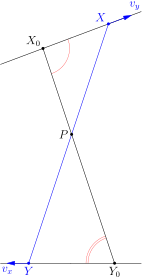
Lemma 5.6. A point lies inside an angle , along whose side a point moves. The line meets the line at a point . Then the ratio of the velocities and of the points and at and is given by the formula:
Proof
Note that the ratio of velocities is the limit of the ratio as tends to zero.
By the law of sines and , so . Letting tend to , we get the claim.
5.16. Let the point . Prove that the ratio of velocities at is .
5.17. A circle touches the sides and of an angle at points and . A point moves along , and a point moves along so that the line is tangent to . How can one find the ratio of the velocities of the points and at ?
5.18. Compute the answer for and .
5.19. A point moves along a circle, and the point is obtained from by projecting the circle to itself through a point . Find the ratio of the velocities of the points and at .
Let us apply what we have learned to a concise solution of one very hard problem.
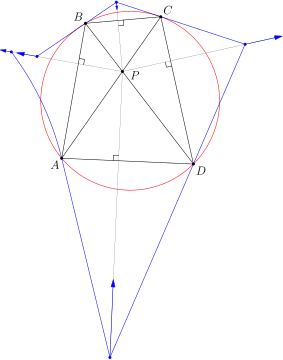
Example 5.8. The non-perpendicular diagonals of a cyclic quadrilateral meet at a point . Denote by , , and the lines through perpendicular to , , and respectively. An arbitrary point is chosen on the line . The line meets at a point , the line meets at a point , and the line meets at a point . Prove that the line meets at the point .
Proof
Fix the quadrilateral and move the point projectively along the line ; then the points , , and move projectively.
It is rather easy to find one trivial position . After some thought one can guess the position where coincides with the orthocentre of the triangle (in this case all the other points of the statement also become orthocentres of the corresponding triangles).
But a third position cannot be found. So, instead of looking for this position, we check the position a second time (that is, we check that the velocities are equal at ).
Let the points move with velocities , , , and respectively. For convenience denote the projections of the point onto the sides by , , and . By the exercise . Writing out the other velocity ratios similarly, we see that:
The last equality holds since the angles split into pairs that cancel; here we use that is cyclic. Interestingly, checking the other positions did not require the quadrilateral to be cyclic.
Thus in any quadrilateral with non-perpendicular diagonals there are exactly two positions in which , and in a cyclic quadrilateral one can additionally catch the velocity at the point . One can show that the equality of velocities implies that the quadrilateral is cyclic or its diagonals are perpendicular; thus the converse problem is also true.
5.20. Where in the solution did we use that the diagonals of the quadrilateral are not perpendicular?
5.21. 2023 lines are concurrent. A circle is inscribed in each of the 4026 angles; the circles touch each other in a cycle. A point is marked on each side of each angle. It is known that for all angles except one, the segment joining the marked points on the sides is tangent to the circle inscribed in the angle. Prove that this is also true for the remaining angle.
5.22. A point is marked inside a convex -gon and joined to all the vertices. It turned out that the incircles of the resulting triangles touch each other in a cycle. Prove that the product of the sines of the half-angles at which the even sides of the polygon are seen from the point equals the product of the sines of the half-angles at which the odd sides are seen.
DaBro
5.23. A line meets a circle at points and . Points are chosen on this line. Prove that the composition of the projections of to itself with centres at the points is the identity if and only if