6.1Cross-ratio on conics. Poncelet's porism
The chapter on conics is a kind of intermediate link between projective and polynomial motion. Let us introduce a notion extending the notion of a homography. Unfortunately, there is no room in this book for a detailed exposition of the theory of conics, so the reader is asked to accept many facts about them without proof. In my opinion, despite the incompleteness of this chapter, it lets one get a better feel for the right intuition of moving points.
Nevertheless, the following chapters will not refer to statements left unproved in this chapter, so the reader can continue reading with a clear conscience, being sure that there is no cheating. In this sense this chapter can be regarded as supplementary material, but it is most natural to take in its material exactly at this place in the book.
Definition 6.1 (Projective transformation of the plane). A projective transformation of the projective plane is a bijective function from the plane to itself that takes lines to lines (an ordinary line may become the line at infinity).
One can show that every projective transformation can be represented as a central projection from one plane to another, if these two planes are placed in three-dimensional space. We will use without proof the following well-known set of statements about projective transformations:
Projective transformations preserve cross-ratios on any line and in any pencil; any chosen line can be taken to the line at infinity by a projective transformation.
Definition 6.2 (Non-degenerate conic). A non-degenerate conic is a curve that is the image of a circle under a projective transformation.
A degenerate conic is a pair of lines or a set of points of one line.
We will use without proof the following statement: the zero set of a quadratic function is a conic (or is empty, or a point), or a conic without one or two points at infinity. When factors into a product of two linear polynomials in , this conic is degenerate, and otherwise it is not.
Here are some examples of conics given in Cartesian coordinates.
- The set of points satisfying the equation is a conic. This conic has no points at infinity (such conics are called ellipses).
- The set of points satisfying the equation , together with the directions of the coordinate axes, is a conic with two points at infinity (such conics are called hyperbolas).
- The set of points satisfying the equation , together with the direction of the axis , is a conic with one point at infinity (such conics are called parabolas).
One can see that Cartesian coordinates are an inconvenient tool for working with conics, since they do not let one see right away how a given conic behaves at infinity. It is also completely unclear so far how to write projective transformations in coordinates; for this reason the theorem that conics and zero sets of quadratic polynomials are almost the same thing is non-trivial.
In the next chapter we will introduce a new kind of coordinates, called homogeneous. It will turn out that in these new coordinates
Theorem 6.1. Through five points , , , and , no three of which are collinear, there passes a unique non-degenerate conic.
Proof
The idea is to come up with a conic passing through the points , , and , and then “adjust” it so that the point also lies on it.
Consider the equation of the line through the points and : (the line consists of the points satisfying the equation ). Similarly consider the function defining the line .
Put ; the zeros of this equation correspond to the union of the lines and , that is, to a degenerate conic passing through the points , , and . It is not hard to find another conic through these points: one should construct in the same way a function whose zeros correspond to the union of the lines and .
Now note that if we fix any two real numbers and and consider the function , then, first, it certainly vanishes at the points , , and ; and second, it is quadratic, that is, its zero set defines some conic.
So it remains only to choose and such that , where . Since the point lies on none of the lines , , and , we have and , so we can put and .
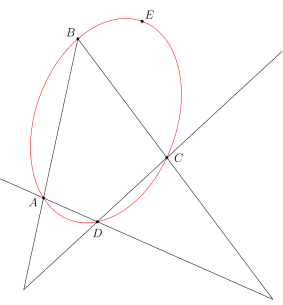
Now let us show that at most one conic passes through five points. Note that a conic meets a line in at most two points: this follows immediately from the fact that a circle meets a line in at most two points (and from the fact that every non-degenerate conic is the image of a circle under a projective transformation).
Let be a line through the point . Let and be the two intersection points of the conic through the points , , , and with the line . Since the points , , , , and lie on one conic, which is the image of a circle under a projective transformation, Pascal's theorem holds for this six of points: , and are collinear.
The point is uniquely determined by the line as , the point is uniquely determined by the point as , so the point is uniquely determined as . Thus we can uniquely determine both intersections of any line through the point with the conic, so the conic can also be determined uniquely.
Just as for a circle, one can define tangency of a line and a conic. Namely, a line is tangent to a conic if it has exactly one common point with it. Note that under the polar transformation with respect to a circle a conic naturally goes to the set of lines enveloping some conic.
Theorem 6.2. Let five lines be such that no three of them are concurrent. Then there exists a unique conic tangent to all five lines.
Proof
Apply the polar transformation with respect to any circle; the problem reduces to drawing a unique conic through five points.
Definition 6.3 (Cross-ratio of four points on a conic). Let points , , , lie on a conic . Mark one more point . The cross-ratio of the points on the conic is the cross-ratio of the lines .
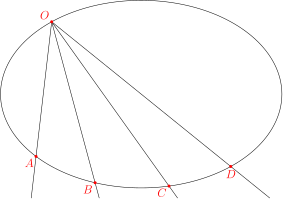
The correctness of the definition follows directly from the fact that a projective transformation preserves cross-ratios and from the definition of a conic as the image of a circle under a projective transformation.
Lemma 6.1. Points and and a homography are given. Then the locus of the intersection points of with is either some conic passing through the points and , or a line.
(Steiner–Sollertinsky)
Proof
Suppose there are three points , , belonging to the locus and not collinear. Draw the conic through the points , , , , . Let us show that the intersection of any other two corresponding lines lies on . Let a line through meet the conic at a point , and let the corresponding line through meet at a point . Denote by the lines through , and by those through . Then:
Hence .
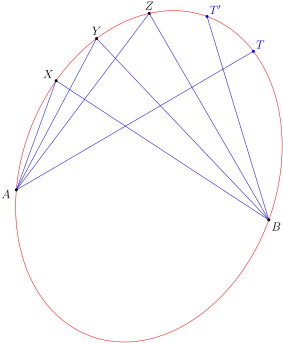
If all the points of the locus lie on one line , then the map assigning to a line through the point its intersection point with the line is a homography. Similarly, the map assigning to a line through the point its intersection with the line is a homography. Since these two homographies coincide at infinitely many points, they coincide at all points. Geometrically this means that the lines through the points and always meet on , and the intersection point visits each point of this line once.
Remark 6.1. In dynamic language this lemma is stated as follows: let lines and rotate projectively about distinct points and . Then their intersection point moves projectively along some line or conic passing through and .
Definition 6.4 (Isogonal conjugation). A triangle and a point not lying on its boundary are given. Reflect the lines , and in the bisectors of the angles , and respectively. Then the three resulting lines are again concurrent at a point , which is called the isogonal conjugate of with respect to the triangle . The isogonal image of a set of points is the set of points isogonally conjugate to the points of the set .
Let us see how the new knowledge helps us solve problems.
6.1. Prove that the isogonal image of a line not passing through the vertices of a triangle is a conic passing through the vertices. The isogonal image of which line is the circumcircle of the triangle (with the vertices removed)?
6.2. Prove that the isogonal image of a circle passing through two vertices of a triangle is a circle passing through two vertices of the triangle (the points common with the boundary of the triangle must be removed from all circles). Which circles go to themselves?
6.3. Points and move projectively along lines passing through the points and respectively, and when . Then the intersection of the lines and moves projectively along some line.
6.4. The side of a triangle is divided into equal segments by points , and the side is divided into equal segments by points . Denote . Prove that all such points are collinear.
6.5. Points and are chosen on the sides and of a parallelogram such that . Prove that the intersection of the segments and lies on the bisector of the angle .
Conics also allow one to describe all homographies from a line to a line .
Lemma 6.2 (Dual Sollertinsky lemma). Let a homography from a line to a line take each point to a point . Then either all the lines pass through one point, or all of them are tangent to a fixed conic that is also tangent to the lines and .
Proof
Denote our homography by . Let points , and (different from the intersection point of the lines) go to the points , and . If the lines , and are concurrent at a point , then the central projection of the line onto the line coincides with at the three points , and , so it coincides with it identically.
Suppose the lines turned out not to be concurrent. In this case consider the conic tangent to the lines , , , and .
Consider the map assigning to each point the point , the point of tangency of the second tangent from to . Note that this map preserves cross-ratios: to see this, it suffices to apply a projective transformation taking the conic to a circle; then we get the lemma on transferring a tangent to a circle.
Similarly, the map that constructs from the point the point , the intersection of the tangent to at with , preserves cross-ratios. Altogether, the map taking to preserves cross-ratios and coincides with at three points, so it coincides with it identically.
Remark 6.2. In dynamic language this lemma can be stated as follows: points and move projectively along lines and . Then the line either passes through a fixed point or envelopes some conic that is also tangent to the lines and .
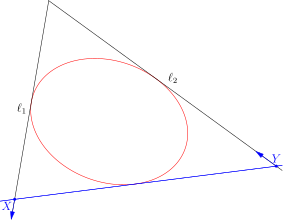
From the last statement it is not at all hard to derive Poncelet's porism for a triangle.
Theorem 6.3 (Poncelet's porism). A triangle is inscribed in a circle and circumscribed about a circle (possibly externally). Let a point also lie on , and let the tangents from it to meet again at points and . Then the line is tangent to .
Proof
Denote by and the intersections of the segment with the segments and , and by and the intersections of the segment with the segments and . Note that there is a homography taking the quadruple to the quadruple :
By the dual Sollertinsky lemma the lines , , , , and are tangent to some conic. On the other hand, the lines , , , and are tangent to only one common conic, the circle . Hence the line is also tangent to this circle.