8.1Definitions and the most important properties
The plan for solving problems by polynomial motion: fix some objects in the picture and “move” others, that is, construct a homogeneous polynomial in the coordinates of the moving object whose vanishing is equivalent to the statement of the problem. Having bounded the degree of this polynomial from above and checked a sufficient number of positions, we solve the original problem.
Suppose a point moves in the plane so that its Cartesian coordinates depend on time rationally. As we saw in examples in the previous chapter, such motion can be expressed in homogeneous coordinates with homogeneous time as , where and are homogeneous polynomials, some of which may be zero (but not all).
8.1. Prove the statement just formulated for arbitrary rational motion. Show that the degrees of all non-zero polynomials are equal.
Definition 8.1 (Degree of dependence). We will say that a point moves polynomially with degree if the homogeneous coordinates of the point can be written as , where and are homogeneous polynomials in time satisfying the following conditions:
- Each of the polynomials is either zero or has degree , and not all of the polynomials are zero.
- The polynomials and are coprime as a whole (that is, there is no homogeneous polynomial dividing each of them).
Notation: . The degrees of dependence of lines are defined similarly.
Let us talk a little more about the second condition. If we drop it, the following problems arise: first, it is unclear what to call the degree of dependence of a point/line on time. Suppose a point is given by the dynamics . Then it can also be given as and .
In the first case it turns out that the point is no longer defined at every moment of time; namely, it disappears at the moment . In the second case this effect is not observed, since (at least for real time).
We see that the dynamics of a point can be given in different ways, so in order to define the notion of the degree of dependence correctly we must agree on the choice of some canonical way.
8.2. Let the dynamics of the same point/line be given both as and as , where the first triple of polynomials is coprime as a whole and the second triple of polynomials is coprime as a whole. Show that the degrees of all non-zero polynomials of these six are equal.
An additional advantage of choosing and coprime as a whole is that the point is correctly defined at every moment of time: indeed, for a triple of coordinates to define a point it is necessary and sufficient that at least one of the coordinates be non-zero. If at some specific moment of time all the coordinates vanished, then by the homogeneous Bézout theorem they would have the common divisor .
Lemma 8.1. Let and be some fixed numbers, and let a point move with degree . Then the point also moves polynomially, and its degree is also at most .
The proof is left to the reader as an obvious exercise.
Finally, let us note that the degree of a point does not depend on the choice of the homogeneous coordinate system. Indeed: as we proved at the end of the previous chapter, when the homogeneous coordinate system is changed, the coordinates of a point transform linearly. So if the point moved with degree in the homogeneous coordinates , then by the lemma, in the homogeneous coordinates the point moves with degree at most . On the other hand, the system is also obtained from the system by some rotation, so similarly .
Thus the notion of the degree of a point does not depend on the choice of the homogeneous coordinate system.
Example 8.1. Let be the circle of unit radius centred at the origin of Cartesian coordinates . Mark also the point . A point moves along the axis so that . The point is the second intersection of the line with . Then the point moves polynomially, and .
Proof
By the computations made earlier, . Passing to homogeneous coordinates with homogeneous time we get: . Clearly, the polynomial is divisible neither by nor by , so the three polynomials defining the point have no common factors, whence .
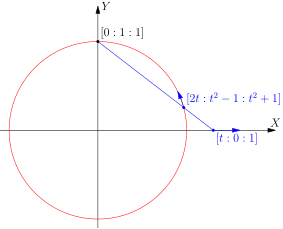
Nevertheless, there are situations in which our intuition fails us. It turns out that a point moving along with constant angular velocity does not depend on the point polynomially! (see the exercises)
Theorem 8.1. To check that a point of degree at most always coincides with a point of degree at most , it suffices to check positions. To check that a line of degree at most always passes through a point of degree at most , it suffices to check positions.
Proof
Let us prove the first part of the statement; the second check is similar. Let
which is equivalent to (if the corresponding pair of denominators does not vanish):
And to check that homogeneous polynomials in two variables of degree at most coincide identically, it suffices to check non-proportional positions.
The second part of the theorem is proved similarly.
Note that we have two different checking procedures: sometimes we check that points (lines) coincide, and sometimes that a point and a line are incident. A little later we will see that checks of the first type have a small advantage over the second.
The following set of exercises will help to see the general geometric properties of points of degree that do not depend on the choice of specific coordinates. These exercises are not necessary, but may help to get a better feel for what is going on.
8.3. a) A point moves with degree 1. Prove that it moves along a line, visiting each point of the line exactly once.
b) A line moves with degree 1. Prove that it rotates in the pencil of a fixed point, becoming each line of the pencil exactly once.
8.4. A point of degree moves along a projective line. Prove that one of the following alternatives holds:
- The point visits each point of this line twice.
- The point moves along some segment (one of the ends of the segment may be a point at infinity), visiting all its interior points twice and its ends once.
- The point moves outside a segment (one of the ends of the segment may be a point at infinity), visiting all points outside the segment twice and its ends once.
8.5. A point of degree moves along a projective line. Let be the set of points visited by the point . Prove that every point of is visited at most times.
8.6. Let be the unit circle centred at the origin of Cartesian coordinates. The point has coordinates , and a point moves polynomially along this circle. Prove that a) the line moves polynomially;
b) the intersection point of the line with the axis moves polynomially.
8.7. In the notation of the previous problem, prove that the point cannot have constant angular velocity.
In general, if time is allowed to take complex values, then a point of degree on a line visits each point of the line, except possibly a finite number of exceptions, exactly times. These exceptional points are called branch points, and the other points regular.
Lemma 8.2 (On adding degrees). Let points and move polynomially with degrees and respectively, and let there be moments of time when , which we will call singular. Then the line also moves polynomially, and its degree is at most .
Proof
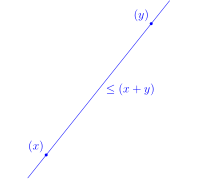
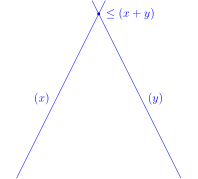
Strictly speaking, the statement of the lemma is not quite correct; we will discuss this a little later.
Denote the homogeneous coordinates of the points by and respectively ( and are homogeneous polynomials in ); then the coordinates of the line are given by . If are polynomials of degree at most , and of degree at most , then these expressions are polynomials of degree at most .
Alas, these polynomials may turn out not to be coprime as a whole. Let be their greatest common divisor. Consider the line given in homogeneous coordinates as ; this object is already a correctly defined polynomial line, whose degree equals , where is the degree of the polynomial .
Note that the line coincides with the line at all moments of time when the line is defined (that is, when ). If at some moment the points merge, then the line becomes the limiting position of the line as tends to . Thus the line is a more correct object both from the point of view of algebra and from the point of view of geometry.
Let us bound the degree of the polynomial . Let at the moment . By the homogeneous Bézout theorem the polynomials have the factor , that is, .
So is divisible by each linear factor corresponding to the singular moments of time. Hence is divisible by their product too, so the degree of is at least .
Let us finally say what is wrong with the statement of the lemma. If one thinks about it, it becomes completely unclear what the line is from the point of view of defining it by a triple of polynomials. Nevertheless, we have a canonical way of defining this line: one should write the formula for the line through two points and cancel the resulting polynomials by their greatest common divisor. It is this object that we will call the line from now on, and not just something given by the polynomials before cancelling their common divisor.
Let us stress once more that these two objects are very similar, since they define the same line at all moments of time except the singular ones. Nevertheless, the main thing in the definition of a variable line is precisely the way it is given by a triple of polynomials, and not its positions at specific moments of time.
The lemma on adding degrees is stated and proved in exactly the same way for intersections of lines.
Remark 8.1. When solving a problem one should not aim to estimate as precisely as possible. In the course of the solution you will be looking for good positions, and in some of them you will be surprised to discover that points merge. In this sense, looking for good moments of time is practically equivalent to looking for singular ones.
The algorithm for solving problems is as follows: first you roughly estimate all the degrees of dependence using the lemma on adding degrees, noting the singular moments that catch the eye. After that you start looking for good moments of time, and some of them also turn out to be singular.
So each honest good moment of time increases the number of positions found by 1, and each singular moment of time decreases the number of positions you need by at least 1 (and in some pleasant cases by more).
8.8. Points , and move projectively along three lines. It is known that these three points were collinear four times. Prove that they are always collinear. Derive from this statement the theorem on collinearity of three linear points.
8.9. Points are chosen on the sides , , of a triangle respectively so that are concurrent, and also , , are concurrent. Denote the intersection of with by , and the intersection of with by . Prove that the points , and are collinear.
8.10. Three lines , and rotate projectively about three distinct points. It is known that these lines were concurrent four times. Prove that they are always concurrent.
8.11. Let points and move with degrees of dependence and respectively. Then the midpoint of the segment moves with degree at most . How should the midpoint of the segment be defined when exactly one of the points is at infinity?
8.12. In the setting of the previous problem, the points and turned out to be at infinity simultaneously times. Prove that then the midpoint of the segment has degree at most . Just as in the lemma on adding degrees, the position of the midpoint of the segment at a moment when both of its ends are at infinity is not very easy to find geometrically: one has to look for the limiting position of the midpoint.
Let us figure out how homography maps interact with degrees of dependence. Let us state a general theorem:
Theorem 8.2. A homography between lines and pencils does not change the degree of dependence. A homography from a line / pencil to a circle (conic) doubles the degree of dependence. A homography from a circle (conic) to a line / pencil halves the degree (in particular, the degree of a point on a conic is always even).
First let us prove the first part of the theorem.
Lemma 8.3. Let a point of degree move along a line , and let a point lie outside this line. Then the degree of the line also equals .
Proof
Denote by the degree of the line . By the lemma on adding degrees . On the other hand, the point can be obtained as the intersection of a fixed line with the line , so , which implies the claim.
Corollary 8.1. A homography between lines/pencils does not change the degree of dependence.
Proof
As we proved earlier, any homography of lines/pencils decomposes into a composition of central projections (possibly with centre at infinity). Each of these projections does not change the degree of dependence, which implies the claim.
Corollary 8.2. Projective motion along a line is linear in homogeneous coordinates and linear fractional in Cartesian ones.
Proof
A projectively moving point has degree of dependence 1, so its coordinates have the form , and hence its Cartesian coordinates are written as
Let us figure out what happens to points that are thrown onto a circle by a homography.
Lemma 8.4 (On doubling the degree on a circle (conic)). Let be a homography from a line (pencil) to a conic . Let move along with degree ; then moves along with degree at most .
Proof
Mark on the circle two fixed points ; then the lines and depend projectively on the point (by the definition of the cross-ratio on a conic), so by the theorem just proved the lines and have degree . The point can be defined as the intersection of two lines with degrees of dependence , so by the lemma on adding degrees its degree is at most .
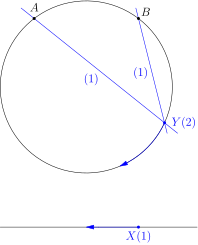
In fact, the bound in this statement is also sharp, which we will prove later. Moreover, when a point is “dropped” from a conic onto a line by a homography, the degree of the point is halved (in particular, the degree of a point on a conic is always even).
Remark 8.2. Along the way we have shown that the degree of a point moving projectively along a circle equals two. Hence, to check that two points moving projectively along a circle coincide, it suffices to check five positions. On the other hand, we already know that in fact three are enough. A similar effect is observed in the general case.
If we need to prove that points and of degrees and moving along the same conic coincide, it suffices to check not positions but only . Indeed: mark an arbitrary fixed point on the conic. We wish to show that the lines and coincide, and their degrees are exactly and .
Generally speaking, we have not yet proved that the degrees of the resulting lines are and , but in practically all real problems this is obvious from the fact that the points and were obtained as images under homographies of some points (or lines) that moved with degrees and along lines (pencils).