8.2Examples of solving problems
Let us see on a simple example how to use moving points to solve problems.
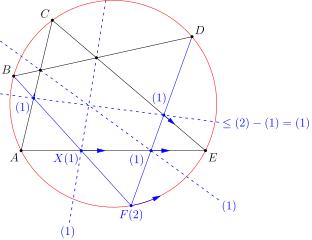
Example 8.2. A convex hexagon is inscribed in a circle. The triangles and form a hexagon in their intersection. Prove that the main diagonals of this hexagon are concurrent.
Solution
Move the point projectively along the circle, keeping the points , , , and fixed.
Under these dynamics the intersection points of the lines and with the sides of the triangle move projectively. Two diagonals of the inner hexagon have degree , and their intersection has degree at most (by the lemma on adding degrees).
The third diagonal also has degree at most , so to solve the problem it suffices to check it in five positions of the point .
Altogether we need to check 1 + 1 + 2 + 1 = 5 positions.
First let us mark in the picture all potential candidates for good positions. These are , , , and . There are exactly five of them, and they split into three groups. Clearly, the positions and are analysed in the same way, as are the positions and .
Let us start with . In this case , so the line through these two points collapses; that is, the corresponding moment of time is singular, and it lowers the degree of the line by 1. Thus this position contributed to the required check, though not as a good position but as an additional improvement of the bound.
The remaining two groups of positions are honest good (non-singular) positions. We invite the reader to deal with them by himself (the pictures will help you).
Remark 8.3. By moving the problem we found out about one of the diagonals that its degree is not two but one. It follows that it passes through some fixed point. After this observation the problem is not hard to solve geometrically too, by explicitly guessing how to construct this point.
So sometimes the method of moving points can be used to guess some geometric relations between objects, after which one solves the problem geometrically.
And here is another example of how honest good positions differ from singular ones:
Example 8.3. A point is fixed on a circle , and a point moves projectively on it. Then the degree of the line equals 1.
Proof
We already know that the line is obtained from the point by a homography, so it rotates projectively. This means that . But this fact can also be proved differently!
Note that by the lemma on adding degrees , since there is a singular moment of time. However, this argument has a significant drawback: now we do not know how the line behaves at : a singularity destroys information about what happens at the corresponding moment of time. Sometimes this information can be established by referring to continuity. In particular, if the points and move along the same trajectory, then the limiting position of the line is the tangent to this trajectory. If the points move along different trajectories, establishing the limiting position of the line is usually much harder.
8.13. A point is such that ( does not necessarily move along a line!). A fixed point is marked on a circle (conic) . The line meets again at a point . Prove that .
8.14. Give an example where the bound from the previous problem is not sharp.
Lemma 8.5. A point of degree two moves either along a line or along a conic. A line of degree two either rotates about a fixed point or envelopes a fixed conic.
The proof of this lemma is not very hard, but we will not need it later, so the proof is left as an optional exercise for the diligent reader. Nevertheless, one should know this lemma in order to picture the dynamics geometrically when solving problems.
8.15. Let be a circle (or a conic), a point not on , and some line. Let a point move projectively along , and let the point be defined as the intersection of the line with . Prove that the point has degree 2. Draw pictures for inside and outside . How does the position of affect the dynamics?
8.16. Points and move projectively along two lines, starting from the points and . Prove that the intersection point of with (when it is defined) moves projectively. Prove that if the points and move linearly, then the intersection point also moves linearly.
Now try to solve some real competition problems. To find good positions it is often convenient to try to make the picture degenerate or to send some points to infinity.
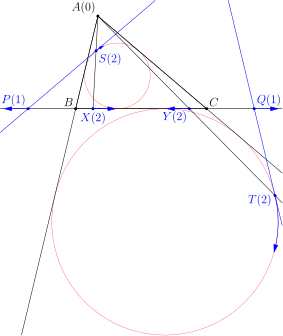
Example 8.4. Points and are chosen on the side of a scalene triangle so that . Let be the incircle of the triangle, and the excircle tangent to the segment . Points and on the circles and respectively are such that is tangent to and is tangent to . and meet at and respectively. Prove that .
Solution
Move the point along the line , keeping the triangle fixed. The map assigning to the point the point is a homography, so . By the lemma on adding degrees and . In fact, it is easy to see that to each position of the point of the segment except and there correspond exactly two positions of the point (and hence two positions of the point ), so all the bounds are sharp.
Similarly . Mark the point symmetric to the point with respect to the midpoint of the segment . Clearly, , and we wish to check that ; for this it suffices to find simple positions. This is rather easy to do:
For the point is the point of tangency of with , and (respectively ). The case is analysed similarly.
For , the point of tangency of with , we have and . In this position coincides with the point of tangency of the excircle, and similarly coincides with it too.
It is a little less obvious which positions to take as the remaining two. First we suggest studying the case . Denote by the point diametrically opposite to the point on . The point must be such that the tangent to at it is parallel to , that is, . Let us show that the point coincides with the point of tangency of the excircle of the triangle with the segment . Consider the homothety with centre at the point taking to . Under this homothety goes to a line that is tangent to and parallel to , that is, to . Hence the line meets at the point of tangency of the excircle. Similarly coincides with the point of tangency of the incircle.
Finally, consider the position , the midpoint of the segment . Let us show that in this case and also coincide with the points of tangency of the excircle and the incircle respectively. Let be the point of tangency of the excircle. As we already know, the points , and are collinear, so , where is the second intersection of with . The triangle is right-angled, so ; hence the line is tangent to . We get that for we have and .
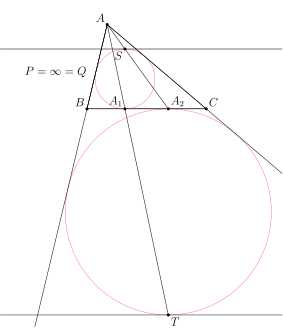
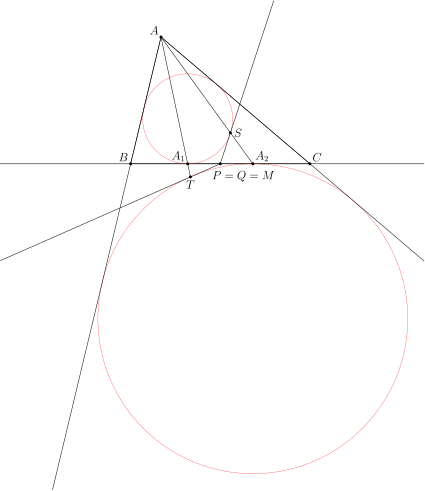
Remark 8.4. (A difficult remark; it can safely be ignored). We could have avoided checking the last two positions if we had acted a little more cleverly. Let and . For convenience we will think that the line is the time line. Formally we are proving that these two functions coincide. In homogeneous coordinates each of these functions is given by a triple of homogeneous quadratic polynomials.
When solving the problem we used the fact that is uniquely determined by its action on five points. One can also discover that almost all points of the line have two preimages (if time is allowed to take complex values). The exceptions are the points and ; such points are called branch points (that is, points with fewer preimages than typical regular points).
Every point in a small neighbourhood of the point has exactly two preimages, so intuitively it seems that the point should also have two preimages that coincide. If our intuition does not fail us, the position of with must be double. The same holds for the point , so the first three checked positions should already suffice to solve the problem. So:
Lemma 8.6. Points and ( from 1 to 3) are marked on a projective line . Then there exists a unique function given in homogeneous coordinates by a pair of homogeneous quadratic polynomials (since we study only one line, two homogeneous coordinates are enough) such that , and the points and are branch points.
Proof
We leave only a sketch of the proof for the sophisticated reader. Passing to Cartesian coordinates, we may assume that . We are trying to compute the coefficients of this function up to proportionality. The condition that the point is a branch point means that the equation has a unique solution, that is, the equation has a unique solution. Denote the left-hand side by . Either the leading coefficient of must cancel, or . Either way, this gives some linear relation on the coefficients. Conditions of the form give three more linear relations. Altogether we have five linear relations on six variables, which we wish to recover up to proportionality. If these relations are independent, the problem has a unique solution. The independence of the relations is not hard to establish.
To simplify the problem one can first apply projective transformations of the preimage line and the image line taking the points and to 0, 1 and respectively.
The lemma can naturally be generalised to non-quadratic maps too.
Note that such a trick can work only when the problem has been reduced precisely to checking that two polynomial maps coincide. Often we need to check that a point of degree lies on a line of degree . In such situations it makes no sense to talk about branch points.
8.17. The excircle of a triangle has centre , touches the segment at a point and touches the lines , at points , respectively. A point is chosen on the line so that . A point is chosen on the line so that . Prove that the points , , are collinear.
8.18. Points and are chosen on the sides and of a triangle respectively so that , , , are concyclic. The lines and meet at a point . and are the circumcircles of the triangles and . is the point diametrically opposite to on . Prove that are collinear.
8.19. A triangle with orthocentre is inscribed in a circle . A line through meets the segments and at points and respectively. Denote by the centre of the circle . The line meets at a point . Prove that the perpendicular dropped from to meets the line on the circle .
8.20.★ Let points , be inverse with respect to the circle , let be symmetric to with respect to , and let meet at a point . The points , are defined similarly. Then , , are collinear.
As can already be seen from these examples, finding good positions is not always easy. One should keep in mind that finding positions is often the most substantial part of a problem. Before starting to look for them, one should soberly estimate whether their number is excessive: problems in which one can effectively check more than 20 positions practically never occur (but perhaps you will find some!)
Before starting to check positions, one should roughly estimate how many good ones you will manage to find. It is recommended to mark all the candidates in advance and then compare their number with the required number. Some candidates will indeed turn out to be good positions, some will be singular moments (even better!), and some will not be easy to check.
Nevertheless, one should not be afraid of large degrees of dependence. It often happens that large degrees indicate that the picture can degenerate in many ways. In particular, one should always pay attention to the various symmetries of the picture: if one arc midpoint is a good position, perhaps the other one is also easy to check; if a point on a circle is a good position, then perhaps so is the point diametrically opposite to it, and so on. Also one should not forget that a triangle can be isosceles in three ways.
Let us discuss one more important idea that helps to find positions:
Suppose a point of degree moves along a line. Roughly speaking, this means that it visits almost all points of its domain times (of course, this is far from always so, but in real problems we often observe exactly such effects). This observation helps to find additional good positions.
Example 8.5. Points and are marked on the circumcircle of a triangle . A point on the side is such that the lines and are symmetric with respect to the line . The points , are defined similarly. Prove that the points , , are collinear.
Solution
Fix the triangle and the point , and move the point projectively along the circle (that is, ). Mark the point symmetric to the point with respect to the line . Clearly, the points and are collinear, so .
Let us note right away that in fact the point moves with degree exactly two, since almost every point corresponds to two positions of the point : the two intersections of the line with the circle .
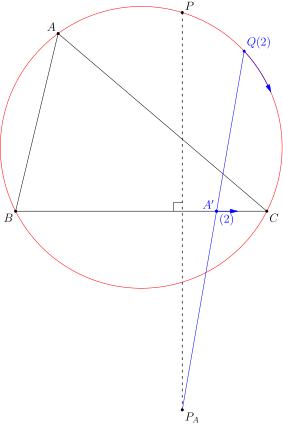
Similarly the points and move with degree 2. Then , and to check the incidence of and it suffices to check it in seven (!) positions. At first glance this number seems excessively large. Only four positions come to mind right away that could theoretically be considered: , , and . Let us study what happens in them.
For the points , and become the feet of the perpendiculars from to the sides of the triangle; they are collinear by Simson's theorem (a reader not familiar with it can easily prove the statement by angle chasing).
For the points and both become the point , so the statement of the problem holds. For the line becomes the line , and the point arrives at the point , so the points are collinear. For the points and merge and the line blinks, which lowers its degree, that is, .
Note that the point , as a point of degree two on the line , visits all regular points twice. Let us think whether there is a moment of time when the point arrives at the point a second time.
Suppose the line meets the circle at a point . At the moment when the point arrives at the point , the point is at the point , and the point is somewhere on the line . In this case the line simply coincides with the line , so one has to check that the point also lies on this line, that is, that .
A simple angle chase shows that the points , and are collinear: ; moreover, the point is simply such that is the midpoint of the arc .
So, when the point moves projectively along the circle, and , so it suffices to exhibit five positions in which the problem is obvious. These positions are , , , , , . However, one must check that these positions are pairwise distinct.
Generally speaking, this may fail. However, clearly, if we move the point on the circle a tiny bit, the five exhibited points will be pairwise distinct.
Then it is easiest to refer to continuity: if we fix and the point and move the point along the circle, all the points of the statement move continuously. We already know that the statement of the problem holds for all positions of the point except possibly a finite number of points. But then the problem must hold at them too, simply by continuity (the coordinates of the points , and are continuous functions of the coordinate of the point , and the condition that these points are collinear is just the statement that some polynomial in the coordinates of , and is identically zero.)
Now try to solve the following problems by yourself. At first glance they may frighten the reader with the number of positions to be checked, but one should not panic and should remember that a large degree of dependence is a plus rather than a minus, since it suggests a large number of positions to check.
Do not forget that a good position can be characterised not by the point you started moving but by some intermediate one.
8.21. In an acute triangle inscribed in a circle with centre , the altitude is drawn. Lines , , touch the circle at the points , , respectively. The point is the orthocentre of the triangle formed by the lines , , . Prove that the lines and are symmetric with respect to the line .
8.22. A point lying inside a scalene triangle is marked on its Euler line; the point is the centre of the circle . The lines , , meet the corresponding sides of the triangle at points , , . Prove that the circles , , have two common points.
8.23.★★ A convex quadrilateral is such that . Prove that the midpoint of the diagonal lies on the common internal tangent of the circles inscribed in the triangles and .
Finally, recall that moving points can also be used to prove tangency of circles, even when the point of tangency is not given in the statement.
8.24.★★ Circles and meet at points and . A point is chosen on the circle and inside the circle so that . A ray from the point meets at a point and at a point . The tangent line to at the point , the tangent line to at the point and the line form a triangle . Prove that the circumcircle of the triangle is tangent to .