1.2Collinearity, perpendicularity and velocity
Let us look at a somewhat different way of using linear motion:
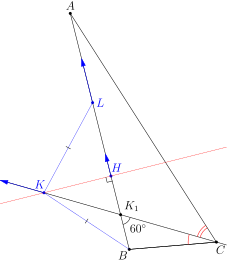
Example 1.2. In a triangle we have . A point is chosen inside the angle , and a point on its side , so that and . Prove that .
Solution
Denote by the intersection point of the lines and (see Fig. 1.4). First of all, note that
Fix the triangle and move the point linearly along the fixed line . The perpendicular dropped from to the line moves linearly, so its foot also moves linearly along the line . Note that the absolute value of the velocity of the point equals the absolute value of the projection of the velocity vector of the point onto the line . Since , we have .
On the other hand, since the triangle is isosceles, the point is obtained from the point by the homothety with centre and ratio , so the speed of is twice the speed of ; hence the speeds of the points and are equal.
It follows that the segment decreases at the same rate at which the segment grows (when the point gets onto the segment , one should think of the length of as negative). Thus it suffices to check the statement of the problem in one position of the point . For it is obvious.
Theorem 1.3 (Three bugs). Let three points , and move linearly. If there are three different moments of time at which these three points are collinear, then they are always collinear.
Proof
Switch to the coordinate system in which the point is fixed and is the origin. Clearly, the points and still move linearly in it. Let their coordinates be and . We want to make sure that the lines and coincide. For this it suffices to see that . Multiplying this equality by the denominators and moving everything to the left-hand side, we get a quadratic polynomial in . To check that it is identically zero, it suffices to check that it vanishes at three different moments of time, and this is given.
Example 1.3 (The Aubert line). Four lines in general position cut out four triangles in the plane. Prove that their orthocentres are collinear.
Solution
Let the lines cut out a convex quadrilateral whose opposite sides, extended, meet at points and (see Fig. 8.1a). Move the line linearly, keeping the other three lines. The points , and move linearly, so the orthocentres of all the triangles also move linearly.
Let us check that any three of the orthocentres are always collinear; by the theorem, three positions are needed for this. Choose three positions of the line in which the configuration degenerates into a triangle; in them the problem is obvious.
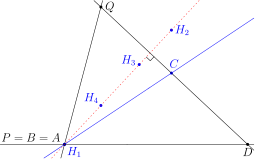
For example, when , all the orthocentres lie on the altitude dropped from to the line (see Fig. 8.1b). The remaining cases are analysed similarly.
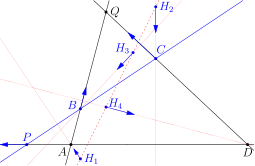
1.10. Four blue lines in general position are drawn in the plane; they cut out a convex quadrilateral and two more points and . Prove that the midpoints of the segments and are collinear.
1.11. Points and move linearly. It turned out that a) b) at three different moments of time. Prove that then this is always true.
1.12. Prove that the Aubert line and the Gauss line are perpendicular.
1.13.★ Prove that in a cyclic quadrilateral the Aubert line passes through the intersection point of its diagonals.
1.14.★★ A quadrilateral has no parallel sides. The lines meet at a point . Points are the circumcentres and the orthocentres of the triangles . Prove that the perpendicular from the midpoint of to , the perpendicular from the midpoint of to and the line are concurrent.
Generally speaking, the line joining two linearly moving points is usually not linear. Nevertheless, there is a useful and easily checked criterion for such a line to be linear.
1.15. Points and move linearly, and there is a moment of time when . Then the line moves linearly.
1.16.★ Points and move linearly, and the line is fixed. Suppose there is a moment of time when . Then the intersection point of the lines and moves linearly.
Note the common feature of the two statements above: if an object that in general should be non-linear simply does not exist at some moments of time (that is, it is a line through two coinciding points or the intersection point of two coinciding lines), this signals that the complexity of the object drops, which prevents it from moving in a more complicated way.
Later we will see that this principle is quite general: a degeneration of a line or a point always simplifies the dynamics of its motion. The corresponding formal definitions and statements will be given later.