1.3Linear motion and circles
Example 1.4. Points and move linearly along the sides and of an angle (starting from the points and ). Then all the circles have two common points or are pairwise tangent at the point .
Solution
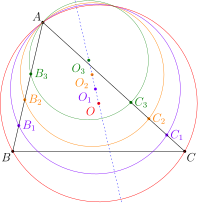
The midpoints of the segments and move linearly; hence the perpendicular bisectors of the segments and move linearly as lines of constant direction through linear points. By Lemma 1.1 the intersection point of the perpendicular bisectors (which is the circumcentre ) moves linearly along some line (see Fig. 1.6). If the line passes through , all the circles are tangent to each other at ; otherwise mark the point symmetric to with respect to . The point is fixed and , so it also lies on each of the circumcircles.
Lemma 1.3. Let lines , and meet at a point , and let points and move linearly along the lines and respectively. Then the point , the second intersection of the circle with the line , also moves linearly (see Fig. 6.4).
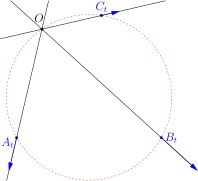
Proof
By Example 1.4 the circle always passes through some fixed point . Now apply the converse statement to the rays , , the moving point and the fixed point : we get that the point also moves linearly.
Remark 1.6. The lemma can be used to prove that four points are concyclic. However, one should carefully interpret the degenerate cases when one or more points get to . If the point coincides with while and do not, then the circle is tangent to the line . If two of the three points coincide with , then the third one coincides with them as well (think why!).
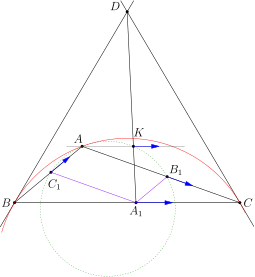
Example 1.5. In a triangle the angle at the vertex is obtuse. Points , and are chosen on the sides , and respectively so that and . The tangents at and to the circumcircle of the triangle meet at a point . The segment meets the line through parallel to at a point . Prove that the quadrilateral is cyclic.
Solution
Move the point linearly along the line , keeping the triangle fixed. Then the points , and also move linearly along the corresponding lines passing through the common point (see Fig. 1.8a). By Lemma 1.3, it suffices to check the statement of the problem in some two positions of the point . For and the problem is not very hard.
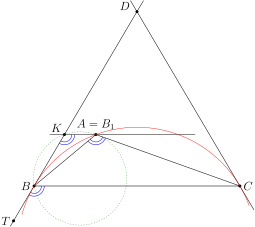
Let us analyse, for example, the case (see Fig. 1.8b). In this configuration , , and we need to show that the second intersection point of the circle with the line is the point , that is, we need to see that the circle is tangent to the line at . Let be an arbitrary point on the ray beyond .
In this notation , which implies the required tangency by the theorem on the angle between a tangent and a chord.
Remark 1.7. Positions at which various gluings happen are called “catastrophes”. There is a rather general trick that allows one to interpret correctly what happens at the moment of a catastrophe: rewind time by some back to before the catastrophe, then let tend to zero and look at the limiting behaviour of the picture.
A common mistake
Let us “prove” that every quadrilateral (not necessarily convex) is cyclic. Fix the vertex and the lines , and , and move the points , and linearly along the corresponding lines in any way, requiring only that they arrive at the vertex at different times.
Since the points move linearly along lines through the point , to prove concyclicity it suffices to prove it at two different moments of time. But we have as many as three obvious positions, when the point coincides with one of the moving points. In each of these positions the quadrilateral degenerates into a triangle, so the statement is trivial in them.
1.17. A triangle is inscribed in a circle with centre . An arbitrary point is marked on the line . The circles and meet the lines and for the second time at points and respectively. Prove that the midpoint of the segment is equidistant from the points and .
1.18. The point is the circumcentre of an acute triangle . A line perpendicular to the side meets the segment and the line at points and respectively. Prove that the points , and the midpoints of the segments and are concyclic.
1.19.★ Points and are marked on the sides and of a triangle respectively. The line meets the circle at points and . Prove that the midpoints of the segments , , and are concyclic.
1.20. Two parallel lines and meet the sides , and of a triangle at points , , respectively . The perpendiculars to the corresponding sides of the triangle drawn through the points , and form two triangles. Prove that the circumcircles of these triangles are tangent.
a) Reformulate the problem in terms of a single line . Let this line move linearly. Prove that the problem is equivalent to the statement that the circumcircles of any two positions of the variable triangle are tangent.
b) Show that at some moment of time the triangle collapses to a point , which is a centre of homothety for any pair of positions of the variable triangle.
c) Reduce the problem to showing that the point lies on the circumcircle of the variable triangle at least at one moment of time.
d) Find where the vertices of the variable triangle are when the variable line passes through a vertex of the triangle . Draw a conclusion about the straight-line trajectories of the vertices of the variable triangle and finish the solution.
1.21.★★★ The point is the projection of the vertex of a triangle onto its Euler line. A circle with centre passing through the points and meets the lines and at points and respectively. Denote by the midpoint of the side and by the foot of the projection of onto it. Prove that the centre of the circle is equidistant from the points and .